REVIEW · MADRID
“Madrid : Panoramic views in Tuk Tuk”
Book on Viator →Operated by TOURIST · Bookable on Viator
Madrid can feel huge. This tour makes it compact.
You sit up in a tuk tuk and zip between iconic places, with frequent short pauses for photos and explanations that connect the dots fast. I like the private group setup (up to 4 people) and the fact that the route mixes landmark power with neighborhood texture. One thing to consider: the Royal Palace ticket is not included, so you’ll want to plan for that extra cost if you want to go in.
I also like how practical it feels. You get pickup offered, a mobile ticket, and the option to customize within reason when timing matters. Even on a rough day, one guide named Henry stood out for adapting and making sure the tour still delivered what you paid for.
The possible drawback is simple: most stops are brief. If you want long museum time or slow wandering, this format will feel a bit too fast. But if you want big Madrid moments with minimal effort, it’s a strong match.
In This Review
- Key highlights to look for on this Madrid tuk tuk ride
- How a private tuk tuk panoramic route keeps Madrid from feeling overwhelming
- Royal Palace viewpoints, Cibeles Fountain, and the goddess stories you can see
- Barrio de Salamanca, the Golden Mile, and how luxury streets tell history
- Fuente de Neptuno, José Bonaparte’s square, and Charles III’s stone fingerprints
- Gran Via like the Spanish Broadway: shopping, street energy, and fast stories
- Los Jeronimos and Barrio de Las Letras: wedding-era church views and writer street scenes
- The Arab Wall origins and Plaza Mayor’s 1618 core
- Price and what $52.93 per group actually buys you
- When this tour fits best, and when you should choose something else
- Should you book Madrid panoramic views by tuk tuk?
- FAQ
- How long is the tuk tuk panoramic views tour in Madrid?
- What is the starting meeting point for the tour?
- Where can the tour end?
- Is pickup included?
- What does the price include?
- Is the Royal Palace admission ticket included?
- How many people is the tour for?
- What language is the tour offered in?
- Is a mobile ticket used?
- Are service animals allowed?
- What is the cancellation window?
Key highlights to look for on this Madrid tuk tuk ride
- Private tuk tuk for up to 4: easier conversation, less waiting around, and a more flexible pace.
- Photo-friendly pull-offs: short stops built around views, not lineups.
- Icon-to-icon pacing: Royal Palace area, Cibeles, Neptune, Gran Via, and Plaza Mayor in one flow.
- Neighborhood texture in the middle: Salamanca’s Golden Mile and the writers’ quarter show up between the monuments.
- Guides who adjust for real life: Henry is mentioned for handling hot days and unexpected disruptions.
- One paid site: Royal Palace admission isn’t included, so budgeting matters.
How a private tuk tuk panoramic route keeps Madrid from feeling overwhelming
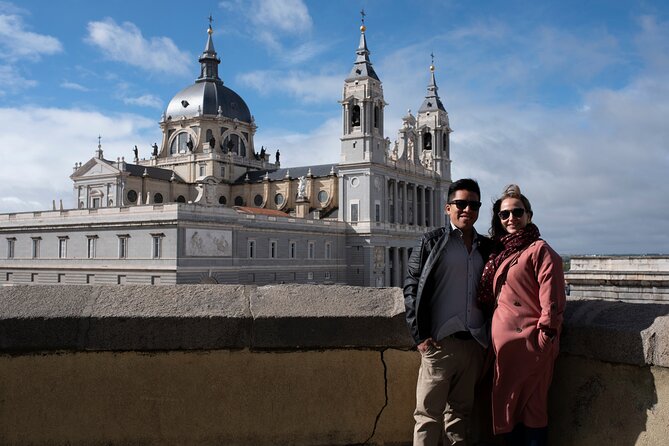
This is the kind of tour that helps you get bearings fast. Madrid has wide boulevards, steep little climbs in spots, and districts that can feel separate even when they’re close. From the moment you start near Plaza de la Villa, the tuk tuk format lets you cover ground without turning your legs into sandpaper.
The timing is built for quick “see it and understand it” moments. You’ll get stops that are long enough to step out, look around, and take a few solid pictures. You won’t spend most of your day inside one place, so your day stays flexible if you’re trying to fit Madrid into a layover, a short trip, or a first visit.
Because it’s private, you’re not trapped in a one-size-fits-all group rhythm. If you care more about architecture, shopping streets, or photo angles, your guide can steer attention toward what fits your time and energy. On a hot day, the tour also includes room for breaks, which sounds small until you’re standing in sun with a smartphone at full brightness.
You can also read our reviews of more tours and experiences in Madrid.


Royal Palace viewpoints, Cibeles Fountain, and the goddess stories you can see
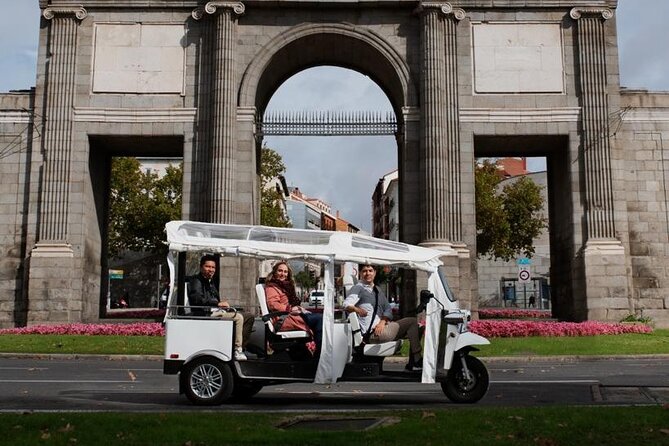
The tour kicks off at the Royal Palace area. You’re guided to a viewpoint from Factor Street, a spot designed for photos if you want that “Madrid from above” feeling without committing to a long detour. The stop is around 10 minutes, which means it’s more about seeing and orienting than touring.
Here’s the useful part: the guide doesn’t just point at a big building. You’ll get quick context about what you’re looking at, including details connected to victory symbolism. If you decide to skip the Palace interior, you can still get the payoff of the exterior views and the story thread that ties the palace to Madrid’s image of power.
Next comes Cibeles Fountain, a classic stop for a reason. You get to see the Goddess of Cybele and related architectural landmarks like Cybele Palace and Casa de América nearby. The time here is short, about 3 minutes, but it’s enough to frame the fountain, snap the most common angles, and understand why it shows up on postcards and in local pride.
For me, this is where the tour starts feeling like a city lesson. Two minutes at the fountain isn’t about reading every plaque. It’s about learning the names and meanings so you recognize Madrid faster the next time you walk around on your own.
Barrio de Salamanca, the Golden Mile, and how luxury streets tell history
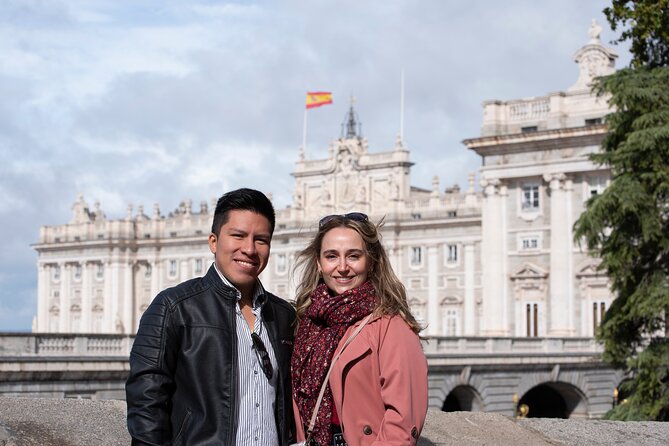
Barrio de Salamanca is where Madrid shifts gears. This is the highest-standing neighborhood in Spain, and the tour uses that idea to connect geography with social history. You get about 20 minutes here, which is long enough to feel the district and still keep momentum.
You’ll hear about the Golden Mile and the gastronomic mile, plus the history linked to the Marquis of Salamanca. Even if you don’t plan to shop luxury, the Golden Mile is useful to see because it shows how Madrid’s modern image grew around elite streets, commerce, and taste.
This stop also includes some “wait, that’s an odd story” moments. There’s a reference to something released in 1885 as a gift for King Alfonso XII for his 28th birthday—then he died at 27. It’s the kind of detail that makes the city feel human and a little dramatic, not just stone and dates.
And then you get one of Madrid’s famous doorways/monuments from the 1700s era, associated with King Carlos III and inaugurated in 1778. The tour frames it as the kind of landmark that defines the city’s identity—so it’s not treated as random sightseeing. It’s presented as Madrid’s visual calling card.
If you’re the type who likes to understand why streets look the way they do, Salamanca is a great mid-tour anchor. It adds variety after the grand monuments and before the next cluster of fountains and squares.
Fuente de Neptuno, José Bonaparte’s square, and Charles III’s stone fingerprints
After Salamanca’s luxury streets, you head to Fuente de Neptuno. This one pairs with Cibeles because it’s presented as Cybele’s sister: another major construction connected to King Charles III. The stop is brief—around 2 minutes—but the key point is that you’re seeing a theme repeated in different forms across the city.
You also get a specific façade detail: it opened in 1850, with the Daois and Velarde lions on the front. Even if you don’t memorize that name, you’ll likely remember the lions and the general look, which makes it easier to recognize Neptune again later when you’re walking.
From there, the tour moves to a favorite square people use in daily life, linked to José Bonaparte, who’s also referred to as Pepe Botella. You’ll hear why he’s described as the most hated king, and how he still helped build the square people end up loving. It’s a clean reminder that history doesn’t always come labeled as good vs. bad. Madrid’s identity was built through complicated chapters.
These fountain-and-square moments are short, but they’re the sort of stops that make the rest of the city click. When you can connect Cybele, Neptune, and the political stories behind the stone, you stop treating Madrid like a photo scavenger hunt.
Gran Via like the Spanish Broadway: shopping, street energy, and fast stories
Next up is Gran Via, the main street that’s often described as the Spanish version of Broadway. You’ll get about 15 minutes here, and it’s a smart use of time because Gran Via is one of those places where you can catch a lot of Madrid’s vibe in a few blocks.
You’ll also hear stories tied to major figures and themes like Artemis, Atlas, and something called the cable girls. The tour frames it as more than a shopping street with prices and storefronts. It’s also a street layered with names and cultural references that show up in the architecture and signage.
The phrase used for the street is a fun one: from Madrid to the sky. Even if you don’t do serious shopping, I think this stop is worth it because it gives you a sense of where the city goes when it wants to feel modern and theatrical.
If your schedule is tight, Gran Via is also one of those places where you can step out, look up, and get the “vertical Madrid” feeling without planning a long walk.


Los Jeronimos and Barrio de Las Letras: wedding-era church views and writer street scenes
You’ll then reach Los Jeronimos. This stop is around 10 minutes. It’s described as a parish where Alfonso XIII was married before the civil war, which makes the viewpoint feel more weighty than a normal street stop. You get spectacular views and a strong chance for an especially memorable photo.
From a practical standpoint, this section is useful because it breaks up the heavy monument run. It feels more grounded and scenic, so the tour doesn’t stay in purely grand mode the whole day.
After that, you head to the Literary Quarter, also called Barrio de Las Letras. You get about 15 minutes here, and it’s centered on the story of Spain’s best writers. Names highlighted include Miguel de Cervantes and Lope de Vega, described with a mix of friendship and rivalry. The area is also tied to excellent gastronomy, so it’s a good stop if you’re hungry and you want to remember where to eat later.
If you’re trying to understand Madrid as a living city, this is one of the most satisfying sections. You see how streets can hold literary identity, not just architecture. And if you happen to spot cafés or small eateries, you’ll know you’re walking in a district built on words and ideas as much as on tourism.
The Arab Wall origins and Plaza Mayor’s 1618 core
The tour then moves to the Arab Wall, presented as the origins of Madrid’s earliest wall. The story here is very specific: Madrid’s founding is linked to people from Morocco and the emir Mohamed I, dated to 865. The stop is only about 5 minutes, but the point is to give you a timeline hook. When you hear 865 in a city that looks modern from most angles, it changes how you experience the walk later.
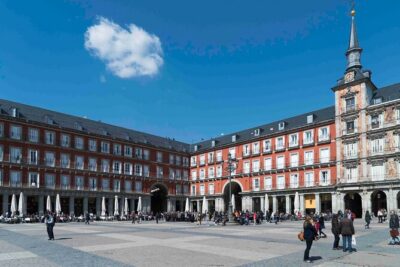
Finally, you end with Plaza Mayor, about 10 minutes. This square was opened in 1618 by King Philip III. The tour also points out the surrounding spots that make Plaza Mayor useful, not just pretty: the San Miguel Market, the cutler street where knife makers lived and worked, and Sobrino de Botín, described as the oldest restaurant in the world.
Even if you don’t eat there, having those names in your head helps. You can treat Plaza Mayor as a hub: a place to orient, grab a bite, and decide where to wander next. The tour also notes that the experience can conclude at any point in central Madrid, but outskirts of central Madrid aren’t included—so plan to stay in the core afterward if you want to keep your day simple.
Price and what $52.93 per group actually buys you
At $52.93 per group (up to 4 people), this is priced like a private day-optimization tool. You’re paying for transportation, not just information. And because it’s private, the cost per person drops fast if you’re traveling as a small group, especially families or pairs.
The one part that can change your total budget is the Royal Palace admission, which isn’t included. If you only care about photos and viewpoints, you can skip the interior and keep spending controlled. If you do want inside access, budget for tickets so you’re not surprised when you reach that stop.
Another practical value piece: the route is designed for orientation. You don’t just see Madrid, you learn enough context to navigate the city afterward. That matters when you want a first-day tour that makes your self-guided walking easier for the rest of your trip.
Based on the way guides are described in the tour experience, Henry-style adaptability is a value too. If the day goes sideways—heat, schedule disruptions, or bigger city issues—the tour experience focuses on making sure you still see the main points. That reduces the chance you’ll feel like you paid for disappointment.
When this tour fits best, and when you should choose something else
This is a good choice if:
- you’re short on time and want a high-hit-rate introduction to Madrid
- you like a mix of landmarks and neighborhood texture (not just one museum or one district)
- you want a guide to connect names, meanings, and quick stories to the places you’re seeing
- you’re traveling with up to 4 people and want private transport value
It’s less ideal if:
- you want long museum time or slow, deep wandering
- you expect all stops to be lengthy
- you’re planning to see the Royal Palace interior and don’t want extra ticket expenses
Should you book Madrid panoramic views by tuk tuk?
Book it if your goal is to get a strong first look at Madrid without burning your whole day walking. The route hits the icons that help you understand the city’s visual identity—Cibeles, Neptune, Gran Via, and Plaza Mayor—then adds neighborhood storytelling in Salamanca and the writers’ quarter. In other words, you’ll get a lot of Madrid for a price that works well for small groups.
Skip it if you already know Madrid well and you want detailed time in one or two major sites. In that case, a slower museum-focused plan will suit you better. But for newcomers, layovers, and visitors who want smart orientation plus memorable photos, this is a very practical way to see the city.
FAQ
How long is the tuk tuk panoramic views tour in Madrid?
The duration can be from 1 to 8 hours, depending on the option you choose.
What is the starting meeting point for the tour?
The tour starts at Plaza de la Villa, Centro, Madrid, Spain.
Where can the tour end?
The tour can conclude at any point in central Madrid, but outskirts of central Madrid are not included in the end point.
Is pickup included?
Pickup is offered. If your pickup address is on a pedestrian street or inaccessible for the tuk tuk, pickup will be at an accessible point closest to where you are.
What does the price include?
The price includes private transportation.
Is the Royal Palace admission ticket included?
No. Admission to the Royal Palace is not included.
How many people is the tour for?
It’s a private tour for only your group, with up to 4 people per group.
What language is the tour offered in?
English is offered.
Is a mobile ticket used?
Yes, a mobile ticket is included.
Are service animals allowed?
Yes, service animals are allowed.
What is the cancellation window?
You can cancel for a full refund up to 24 hours in advance of the experience’s start time.