REVIEW · MADRID
Madrid Expert Tour with Local Guide in Eco Tuk Tuk Private
Book on Viator →Operated by Eco Tuk Tuk - Spain · Bookable on Viator
Madrid makes a big impression fast. This private electric eco tuk tuk tour gives you a smart, time-saving overview with a no-queues start, and it comes with winter blankets if you need them. The one catch: your stops for photos are fixed, so if you want long, flexible museum time, you’ll need a separate plan.
I like this setup because it trades slow transit for movement and context. In about three hours, you get architecture, landmarks, and neighborhood contrasts—from grand civic buildings to the Salamanca streets—without turning your day into an endless hike. It’s also a good fit for different ages since the vehicles are designed for easier boarding, and the driver can help when needed.
In This Review
- Key things I’d plan around (before you go)
- Why this eco tuk-tuk tour works for Madrid orientation
- Meeting at Puerta del Príncipe: start point clarity matters
- How the route is paced: fast highlights, short stops, controlled timing
- Covered Market (c. 1916): where food culture shows up immediately
- Atocha Station: Madrid’s busiest hub, explained on the move
- Palace of the Spanish Courts: the architecture has serious details
- Neptune Fountain at Plaza de Cánovas del Castillo: a classic photo anchor
- Prado-adjacent art and the big painting names you’ll remember
- San Jerónimo el Real (Los Jerónimos): late Gothic with royal gravity
- Puerta de Alcalá: neoclassical triumph with five openings
- Barrio Salamanca: quick taste of upscale streets without a big shopping detour
- Santiago Bernabéu and Paseo de la Castellana: football as a landmark
- Columbus monument and Gardens of Discovery: a calmer pause in the city
- National Library of Spain (BNE): for book lovers and big-scale places
- Plaza de Cibeles: the fountain, the power buildings, and Real Madrid’s echo
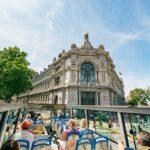
- Bank of Spain building: impressive from outside, selective inside
- Plaza de Santa Ana and San Francisco el Grande: Madrid’s classic corners
- Almudena Cathedral: a modern cathedral with a papal moment
- Royal Palace and Campo del Moro: royal gardens and real size
- Templo de Debod: the free Egyptian temple stop that feels surprising
- Is it worth $28.67? The value math that matters
- Should you book this Madrid Eco Tuk Tuk tour?
- FAQ
- How long is the Madrid Expert Tour?
- Is this tour private?
- How many people can ride in each tuk-tuk?
- What language is the tour offered in?
- Does the tour provide blankets or rain protection?
- Does the tour run in rain or heat?
- Where is the meeting point near the Royal Palace?
- Is Templo de Debod free to visit?
- Can I cancel and get a refund?
Key things I’d plan around (before you go)
- A private ride in an all-electric tuk-tuk: your group goes together in vehicles reserved for you only.
- Fewer logistics headaches: it starts without queues or waiting, so you can use your first hours well.
- Comfort is part of the package: blankets/protective layers are provided in cold weather.
- Photo stops are pre-planned: great for timing, but you can’t swap locations on the fly.
- Big Madrid in a small window: you’ll see major sights across several districts, not just one neighborhood.
- Guides set the pace and tone: many guides are praised for keeping the tour fun, light, and well-paced.
Why this eco tuk-tuk tour works for Madrid orientation
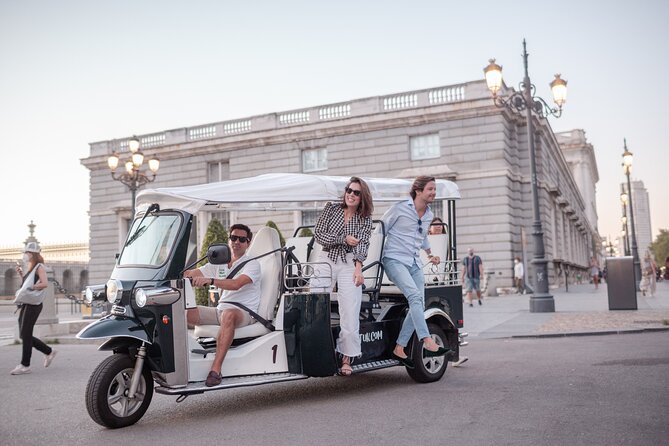
Madrid is not a city that waits politely while you decide where to walk. This tour solves that. Instead of bouncing between scattered points, you’re whisked along in a 100% electric and sustainable vehicle, guided by someone who ties landmarks together so they make sense as you go.
The best value is not any single monument. It’s the “map in motion” effect. By the time you’re done, you usually know what’s where: where the big museums cluster, where the royal sights sit, and how the city shifts from older center to wider boulevards.
You also get practical momentum. The tour starts without queues or waiting, and it’s designed as an overview. That’s especially useful if you’re on day one or if you only have a half day and want to make the most of it.
The vibe tends to be upbeat and conversational. From the guides you might get—names like Jaime, Lucia, Carlos, Manuel, Gustavo, Alex, Alejandro, John, and more—you can expect a mix of history and humor, and a pace that doesn’t feel rushed or lecture-y.
You can also read our reviews of more guided tours in Madrid
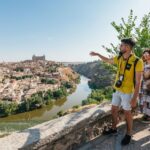
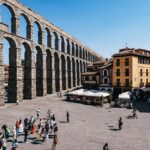
Meeting at Puerta del Príncipe: start point clarity matters
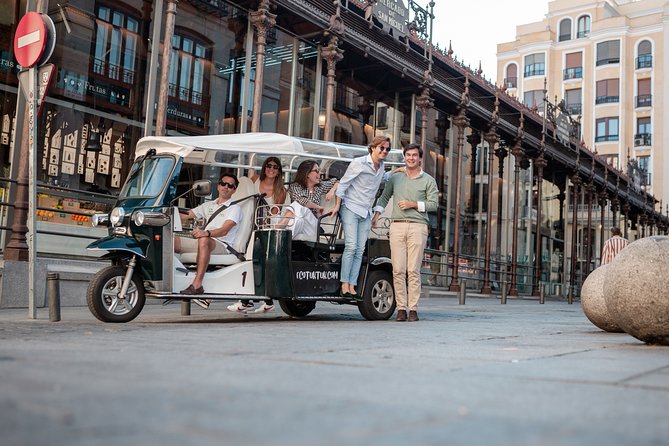
The meeting point is listed as C. de Bailén, 4, Centro, 28013 Madrid. The pickup, though, is inside the bus station (underground) by Plaza de Oriente, right next to the Royal Palace.
If you’re using Google Maps, look for Calle Bailén 4 or Puerta del Príncipe. The key detail is that the location can be confusing—there isn’t an obvious “number 4” right where you expect it. The good news: the stairs to access the underground station are opposite Puerta del Príncipe, and you’ll spot the Eco Tuk Tuk signage.
This matters because tuk-tuks depart on schedule. The tour can reduce time if you’re delayed, and there’s no refund if you’re late beyond the cutoff. So treat this meeting point like an appointment, not a suggestion.
How the route is paced: fast highlights, short stops, controlled timing
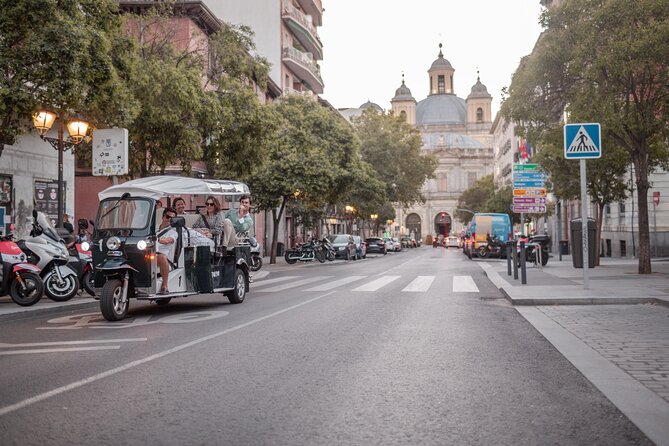
This is a private tour, so your group rides together. Tuk-tuks are reserved privately, and each tuk-tuk fits up to 4 passengers (the legal maximum). For bigger groups, you may use multiple tuk-tuks.
Timing is built around visibility and photo opportunities. The stops for photos are pre-selected, and the tour can’t be modified for additional photo breaks. That’s a benefit for keeping things smooth in a busy city—but it means you won’t be able to say, I want five more minutes here, if the schedule doesn’t allow it.
Also, the tour runs in rain or heat. They only cancel under extreme conditions. That’s why the comfort kit matters: you’ll have blankets and protective layers against wind and cold.
Covered Market (c. 1916): where food culture shows up immediately
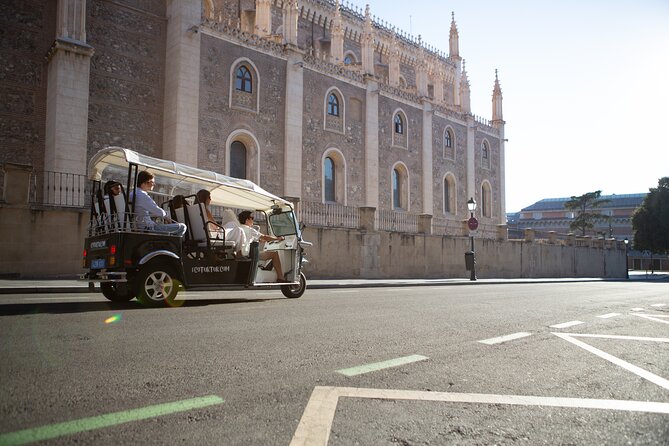
The tour kicks into “Madrid today” mode at a covered market dating from around 1916, where you’ll see local food and delicatessens in an elegant setting, plus events. Even if you don’t go deep into a tasting stop, this kind of market matters because it’s one of the most local experiences you can get quickly.
What to pay attention to:
- The atmosphere. Markets like this are built for everyday life, not just tourism.
- The mix of food stalls and dressed-up market spaces—Madrid does both.
- The sense of routine: people treating it as a destination for normal errands.
The downside? You won’t get a long shopping spree during a 2–4 hour circuit. Think of it as a cultural hit that points you to where you might return later.
Atocha Station: Madrid’s busiest hub, explained on the move
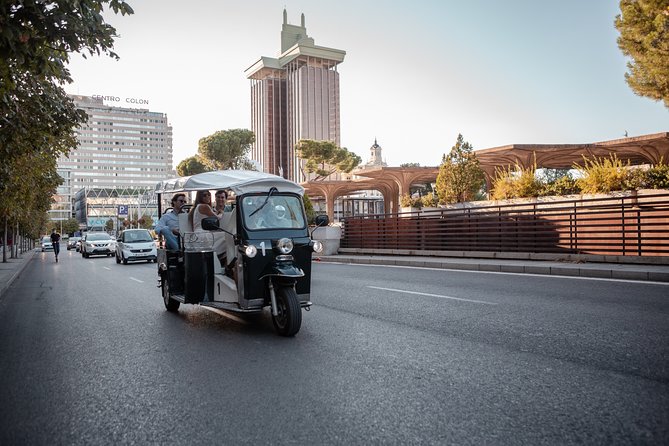
Next is Atocha station, a railway complex near Plaza del Emperador Carlos V. It’s described as the busiest station in Spain and one of the busiest in Europe.
This stop is useful even if you don’t use trains that day. Atocha is one of those landmarks that quickly tells you how Madrid connects: it’s a transport brain as much as it’s a sight.
A good guide can turn this into something more than “a big station.” You’ll likely get context on why it’s so central and why Madrid routes people through here.
You can also read our reviews of more private tours in Madrid





Palace of the Spanish Courts: the architecture has serious details
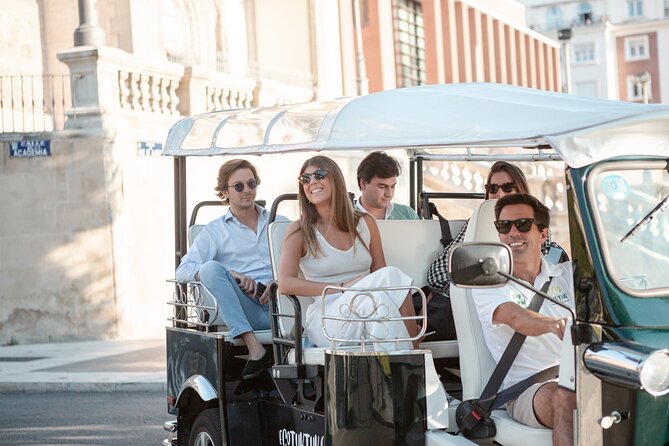
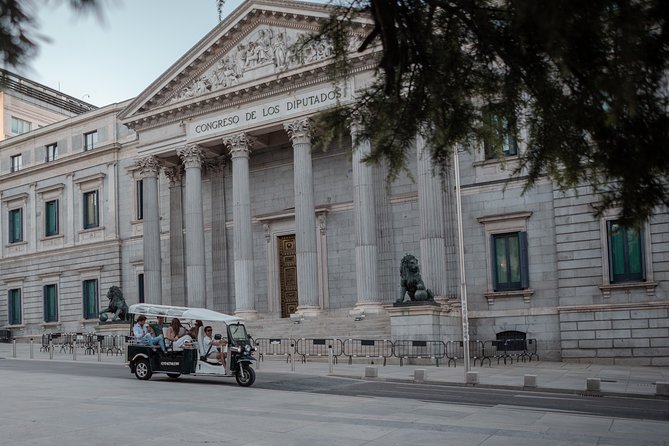
Then you get the Palace of the Spanish Courts—a building tied to the former convent of the Holy Spirit, which served as the seat of Congress in the early 1800s.
From the exterior, look for:
- The impressive main facade and staircase to the neoclassical portico
- The six striated Corinthian columns
- The triangular pediment with reliefs
- The lions flanking the entrance, cast with iron from cannons captured during the war in Africa
It’s the kind of place where the small stories make the big facade worth your attention. Also, there’s a detail that adds atmosphere: the bronze door only opens on very marked occasions, so don’t assume you’ll stroll inside on this tour.
Neptune Fountain at Plaza de Cánovas del Castillo: a classic photo anchor
The Fountain of Neptune sits in the center of a roundabout at Plaza de Cánovas del Castillo. It’s neoclassical and monumental—proposed in 1777, with construction starting in 1782 and finishing in 1786.
This is a great stop because it’s visually clear and easy to frame. Roundabouts can feel chaotic on foot, but from a tuk-tuk with quick photo timing, it becomes one of those “check the landmark box” moments that still looks special.
Prado-adjacent art and the big painting names you’ll remember
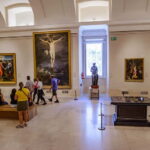
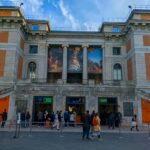
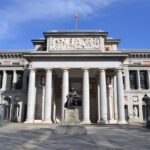
One major stop is an art museum presentation with a strong emphasis on European painting from the 16th to the 19th centuries, and it highlights the breadth of collections tied to artists like Velázquez, El Greco, Goya, Titian, Rubens, and El Bosco.
The most useful part for you is not just that it’s famous. It’s that you get a guided sense of where to focus later. When you walk into the Prado on your own day, your brain won’t start from zero.
Practical bonus tip from a guide you might hear: someone shared that the Prado can be free after 6pm. If that’s true for your dates, it’s a smart way to stretch your ticket budget. If it’s not, you’ll still have a clearer plan for what to see.
San Jerónimo el Real (Los Jerónimos): late Gothic with royal gravity
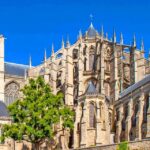
Next is San Jerónimo el Real, popularly called Los Jerónimos. It’s late Gothic with Renaissance influences from the early 16th century. The original building has been remodeled and restored multiple times, so expect layers rather than one pure style.
What makes it compelling is the royal connection:
- Built by order of the Catholic Monarchs
- Used for spiritual retreat across monarchs’ history
- A site tied to royal investitures because Madrid lacked a cathedral for a long time
- Alfonso XIII’s wedding took place here, and the great stairway leading to the door was built in 1906
This is a stop where you benefit from listening as you look. A guide can connect the church’s status to Madrid’s political and religious history so it doesn’t feel like just another pretty facade.
Puerta de Alcalá: neoclassical triumph with five openings
Then comes Puerta de Alcalá, the neoclassical triumphal arc designed by Francesco Sabatini. It was inaugurated in 1778 and was built by Carlos III to replace an earlier 16th-century gate.
A neat detail that makes it stand out: it has five openings, not the usual three. That changes how you read the monument—your eyes notice the extra rhythm and width.
Inside-face vs outside-face matters too:
- The inner face includes the virtues: Prudence, Justice, Temperance, and Fortress
- The exterior side is more decorative, with the royal shield approach and wealth of ornament
It’s also a reminder that Madrid’s monumental style borrowed from Rome and evolved its own neoclassical identity.
Barrio Salamanca: quick taste of upscale streets without a big shopping detour
From there, you head into Barrio Salamanca, covering main streets like Velázquez, Ortega y Gasset, and Serrano.
This is a smart contrast after older civic and religious stops. You get a glimpse of the city’s upscale side: wider streets, big-name addresses, and a different energy than the historic center.
The trade-off is simple: you won’t have hours to browse. But you’ll see enough to decide whether you want to come back for shopping, cafes, or a slower evening stroll.
Santiago Bernabéu and Paseo de la Castellana: football as a landmark
The tour travels along Paseo de la Castellana from Salamanca toward Santiago Bernabéu Stadium. The stadium was inaugurated on December 14, 1947, and its capacity is listed as 81,044 spectators.
Even if you’re not a hardcore fan, the stadium is an easy landmark to recognize and to use as a mental reference point for where the city’s major avenues run.
Many guides also make this stop fun in a very Madrid way—football is part of daily conversation here, not just a game. If you want to ask questions, this is a good moment.
Columbus monument and Gardens of Discovery: a calmer pause in the city
After Bernabéu, you’ll see the Christopher Columbus monument presiding over the square from a central fountain. It’s white marble in a neo-Gothic style, about 17 meters tall, built in 1885 by Jerónimo Suñol for the wedding celebration between Alfonso XII and María de las Mercedes de Orleans.
Nearby is the Gardens of Discovery, opened in 1970. It’s a park where you can admire sculptures, including one tied to the discovery of America.
This works well because it gives a breather between major civic and cultural stops. It’s not an hours-long attraction, but it helps break up the “see-see-see” rhythm.
National Library of Spain (BNE): for book lovers and big-scale places
You also pass by the National Library of Spain (BNE) area. It’s an autonomous body responsible for depositing Spain’s bibliographic and documentary heritage.
The scope numbers are what hit:
- around 30 million publications since the beginning of the 18th century
- collections including books, magazines, maps, prints, drawings, scores, and brochures
- info disseminated through museum and exhibition halls
If you love libraries, archives, and serious public institutions, this stop feels meaningful. If you don’t, the scale still communicates that Madrid invests in cultural infrastructure.
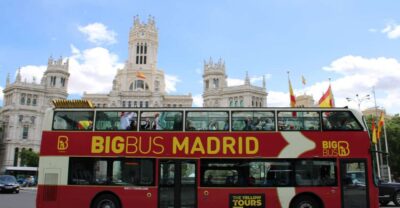
Plaza de Cibeles: the fountain, the power buildings, and Real Madrid’s echo
Then you reach Plaza de Cibeles, with the famous fountain dedicated to the Roman goddess Cibeles, symbolizing land, agriculture, and fertility. She’s depicted in a car pulled by two lions, with Hipomenes and Atalanta named as mythological characters.
Material details are part of the story:
- goddess and lions are carved in marble
- the rest is in stone
And yes, it’s a sports landmark too. The fountain is strongly linked to Real Madrid fans because titles and celebrations play out around it.
You’ll also see nearby heavyweight institutions:
- Palacio de Buenavista (Army Headquarters)
- Palacio de Linares (Casa de América)
- Palacio de Comunicaciones (formerly post office, now City Council of Madrid)
- Bank of Spain (described in the route as a building with strong artistic aims)
Bank of Spain building: impressive from outside, selective inside
The tour includes context about the Bank of Spain building and why it looks the way it does. The description notes it was built to provide a seat fitting the importance of the national bank’s functions, and it mentions a decorative award at the National Exhibition of Fine Arts in 1884.
Important practical point: the interior is described as only visitable by groups from educational centers and universities, with exceptional access for certain non-profit cultural and associative entities. So this is mostly an “admire from outside and move on” moment.
Plaza de Santa Ana and San Francisco el Grande: Madrid’s classic corners
Next up is Plaza de Santa Ana, an open space in the Cortes neighborhood in the Centro district. It dates to 1810 and has gone through multiple urbanization phases that changed its appearance over time.
Then you visit Royal Basilica of San Francisco el Grande (officially Basilica of Our Lady of the Angels) in the Palacio neighborhood within historic Madrid. It’s another “big sacred Madrid” stop that helps round out the city’s spiritual and architectural identity.
Almudena Cathedral: a modern cathedral with a papal moment
Almudena Cathedral is described as the most important religious building in Madrid and was consecrated on June 15, 1993, by Pope John Paul II. It’s noted as the first consecrated cathedral outside Rome.
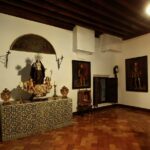
There’s also a museum angle in the plan: the cathedral museum gathers dozens of objects telling the story of Madrid’s diocese, presented across twelve rooms. You might not have time for a full museum deep dive during a short tour, but even a quick look helps you understand the scale and theme of the place.
One simple piece of advice from the broader tour context: if your guide gives you time, it’s worth stepping inside when possible. People love it for good reason—the architecture and lighting are part of the experience.
Royal Palace and Campo del Moro: royal gardens and real size
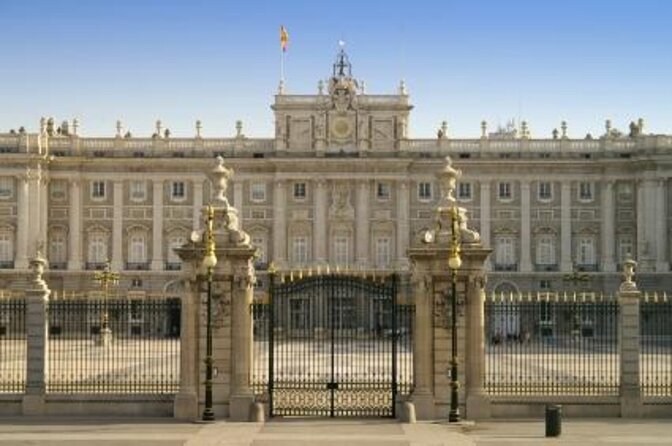
Finally, you reach Palacio de Oriente, the Royal Palace of Madrid. Construction began in 1738 and lasted seventeen years. Carlos III established his habitual residence there in 1764.
The palace is surrounded by gardens:
- Campo del Moro, on the west, with origins described as dating from the Middle Ages
- Sabatini gardens, created in the 20th century, in the north
Campo del Moro is described as about 20 hectares, stretching from the western façade of the Royal Palace to the promenade of the Virgin of the Port. It’s also listed as declared historical-artistic interest in 1931. Daytime visiting is mentioned, which means it’s a great place for a follow-up stroll if the tour timing lands well for you.
This is a strong finale because you see how Madrid treats grandeur—not as a single building, but as a whole royal landscape.
Templo de Debod: the free Egyptian temple stop that feels surprising
To wrap things up, the plan includes Templo de Debod, an ancient Egyptian temple located in Madrid west of Plaza de España. It’s near Paseo del Pintor Rosales and sits on a hill where the Mountain Barracks was located.
You get a short stop—about 15 minutes—and admission is listed as free.
This is one of those “Madrid does random things really well” moments. It’s not a long detour, but it gives you a new angle on Madrid’s international connections, especially compared to the Spanish monuments earlier in the route.
Is it worth $28.67? The value math that matters
At $28.67 per person, you’re paying for:
- a private, reserved eco tuk-tuk setup (not just a generic ride)
- an expert guide/driver included
- pre-selected photo stops
- a tour designed to start without queues
- comfort layers like blankets and protective gear
The value is strongest if you want orientation and context quickly. If you’re trying to cram in major sights over a tight schedule, this is often cheaper than paying for several separate taxis or spending half a day figuring out logistics.
If you’re the kind of traveler who loves long museum time at a single place, you may find the short stops don’t scratch the itch. In that case, treat this as your “framework tour.” You’ll see enough to choose what to go back to.
Should you book this Madrid Eco Tuk Tuk tour?
I’d book it if:
- you want a first-day overview to get your bearings
- you’d rather ride than walk in heavy crowds
- you want comfort for wind/cold with blankets
- you like guides who keep things entertaining and paced for real families and mixed ages
I’d skip or adjust expectations if:
- you need highly flexible timing to linger inside multiple buildings
- you’re planning around a strict museum-by-museum schedule and only care about one neighborhood
If you book, do one smart thing: plan a longer follow-up visit to the places that hook you the most—especially the museum stop and the cathedral/royal area—since this tour is designed for seeing the city’s big picture, not replacing those full experiences.
FAQ
How long is the Madrid Expert Tour?
It runs for about 2 to 4 hours (approximately), and the most common experience length is around three hours.
Is this tour private?
Yes. It’s a private tour/activity, and only your group participates. Tuk-tuks are reserved privately.
How many people can ride in each tuk-tuk?
The legal maximum per tuk-tuk is 4 passengers.
What language is the tour offered in?
The tour is offered in English.
Does the tour provide blankets or rain protection?
Yes. The tour includes blankets and protective layers against rain and wind for cold weather.
Does the tour run in rain or heat?
Yes, tours take place in rain or heat, and they can only be cancelled under extreme conditions.
Where is the meeting point near the Royal Palace?
The start is listed as C. de Bailén, 4. Pickup is in the underground bus station of Plaza de Oriente, next to the Royal Palace, near Puerta del Príncipe. You can also look for Calle Bailén 4 or Puerta del Príncipe on Google Maps to find the exact spot.
Is Templo de Debod free to visit?
Yes. The Debod Temple stop lists admission ticket free and a duration of about 15 minutes.
Can I cancel and get a refund?
Yes. You can cancel up to 24 hours in advance for a full refund. If you cancel less than 24 hours before, the amount paid will not be refunded.