REVIEW · MADRID
Madrid Express Tour with Local Guide in Eco Tuk Tuk Private
Book on Viator →Operated by Eco Tuk Tuk - Spain · Bookable on Viator
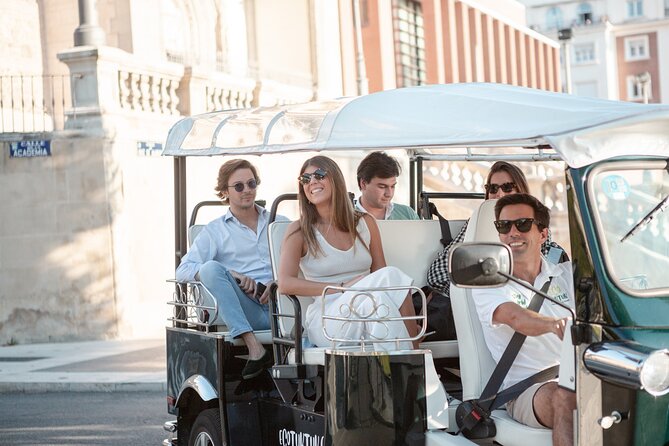
Madrid feels big, until you ride this. A private eco electric tuk tuk tour is a fun way to get oriented fast, with a local guide steering you past the city’s major landmarks without the usual waiting around. You’ll also get built-in photo stops, so the tour feels like progress, not a scavenger hunt.
I especially like two things: the winter blankets and protective layers that make the ride comfortable when Madrid gets chilly, and the fact it starts without queues or waiting. Guides such as Esther and Juan (and also Carlos, in many bookings) keep things clear, fast, and easy to follow in English, and you can ask questions as you roll along.
One possible drawback: the tuk tuk’s roofline can make it tougher to look straight up at taller buildings, and on very hot days the enclosed coverings may not feel great.
In This Review
- Key things to know before you go
- Why an eco electric tuk tuk is the fastest way to orient yourself
- Meeting at Plaza de Oriente and finding your tuk tuk quickly
- How the “express” loop actually teaches Madrid
- The food-market stop: a 1916 foundation for modern Madrid
- Atocha Station: the busiest hub that still feels human
- The Palace of the Spanish Courts: politics meets grand architecture
- The city’s art center: Prado Museum without the maze
- San Jerónimo el Real: a Gothic-Renaissance church beside the Prado zone
- Plaza of sports rivals: Cibeles and Neptune in the same breath
- Puerta de Alcalá: the grand neoclassical gate with a story
- Banco de España: an exterior worth pausing for
- Plaza de Santa Ana: a classic square in the Cortes area
- Almudena Cathedral: a consecrated landmark with a museum inside
- Royal Palace area: the grand ending point you can photograph fast
- Price and time: is $28.67 per person good value?
- Comfort, safety, and the couple of things to plan for
- Should you book the Madrid Express Eco Tuk Tuk Tour?
- FAQ
- How long is the Madrid Express Tuk Tuk tour?
- Is the eco tuk tuk tour private?
- What language is the tour guide speaking?
- Are blankets provided for cold or rainy weather?
- Does it start with lines or waiting?
- What happens if I cancel?
- Can I modify the route or ask for additional photo stops?
Key things to know before you go
- 100% electric ride: quieter, smoother, and better for central streets than older engines.
- Private vehicle for your group: no mixing with strangers; up to 4 passengers per tuk tuk.
- Blankets + wind/rain protection: helpful in winter and whenever the weather turns.
- No-queue start: you begin with momentum instead of standing in line.
- Guides who keep it practical: clear English, city pointers, and room for questions on the move.
- Route can flex: closures or demonstrations can shift the plan, and delays can shorten time on the ground.
Why an eco electric tuk tuk is the fastest way to orient yourself
Madrid has a lot of “wow” sights, but they’re spread out enough that your first day can turn into walking and transit puzzles. This tour solves that with an easy vehicle ride that still lets you stop and look. The eco electric part matters too: the ride feels more relaxed, and it’s a good fit for dense central neighborhoods.
The real value is pacing. You’re not doing museum ticket math or “what bus goes where” planning. Instead, your guide strings together the big landmarks you’ll want to remember later when you’re exploring on foot.
It also helps that the tour starts with no queues or waiting. You’re not wasting your energy before you’ve even started seeing Madrid.
You can also read our reviews of more guided tours in Madrid
Meeting at Plaza de Oriente and finding your tuk tuk quickly

The meeting point is close to the Royal Palace area, which is handy because you’ll already be in the action. The pickup is at the underground bus station of Plaza de Oriente, right by the Royal Palace. The address given is C. de Bailén, 4—but the practical trick is using Google Maps for Puerta del Príncipe to find the exact spot.
From there, it’s stairs to access the station entrance, and you’ll look for the Eco Tuk Tuk signage. If you have mobility needs, the company notes that help is available, and you can contact them for elevator access to reach the meeting point.
Bring your confirmation on mobile—this experience uses a mobile ticket—and aim to show up on time. If you’re delayed, the ride can be reduced, and after a 15-minute delay the activity may be cancelled without a refund.
How the “express” loop actually teaches Madrid
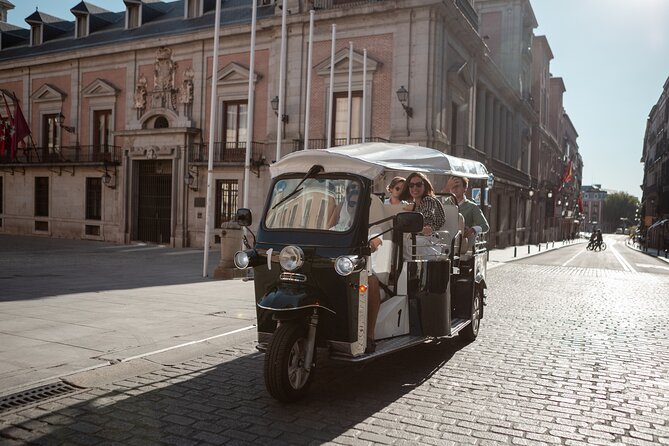
Even when the tour is called an express, it still functions like a guided crash course. Your guide ties together how Madrid grew: markets and daily life near major hubs, government and grand architecture near the center, and then art and religion around the museum zone.
You’ll also notice something else: the tour makes the city easier to read. After a couple of moving stops and short looks, you start recognizing the neighborhoods and axes—so later, when you wander, Madrid feels less like a map and more like a place.
And because it’s private, the guide can steer the commentary to your pace. In real bookings, guides like Esther and Juan were praised for being clear and friendly, and Carlos was called out for making a tight route feel packed with meaning without feeling rushed.
The food-market stop: a 1916 foundation for modern Madrid
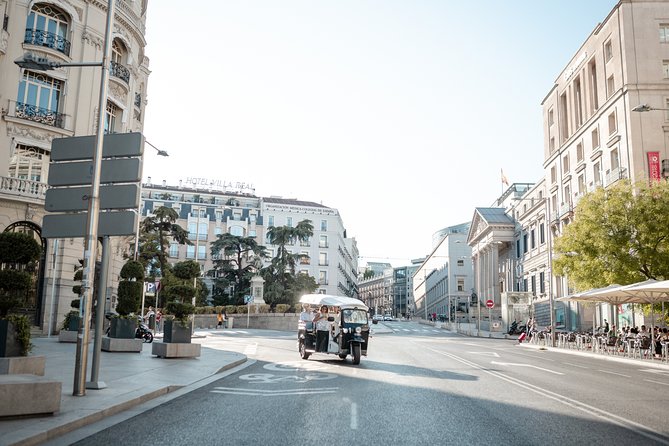
One early stop is a century-old food market that opened in May 1916. It later became the first gastronomic market in Madrid (starting in May 2009), and in 2018 it went through consolidation of much of its food and chef lineup.
Why it’s a great stop on a tuk tuk tour: it anchors Madrid in real life. This isn’t just royal stone and big museums. It’s a reminder that Madrid’s identity also lives in its stalls, chefs, and the energy of people grabbing lunch.
A quick caution: this kind of stop can pull you into lingering. If you’re on an express schedule, treat it like a photo-and-orientation moment, then plan a full return later if the food scene calls you back.
Atocha Station: the busiest hub that still feels human
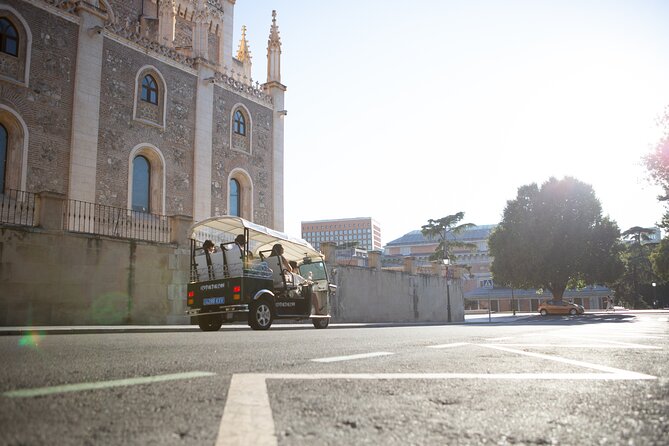
Next up is Atocha station, the railway complex near Plaza del Emperador Carlos V. It’s described as the busiest station in Spain and one of Europe’s major stations.
This stop works even if you’re not a train person. It shows you where Madrid funnels people in and out—useful context for understanding where the neighborhoods connect. It also gives you a sense of scale: Madrid isn’t just historic; it’s busy now.
Practical note: stations can be lively and take more time than you expect. The tuk tuk helps because you’re seeing the landmark without being stuck inside the flow for long.
You can also read our reviews of more private tours in Madrid





The Palace of the Spanish Courts: politics meets grand architecture
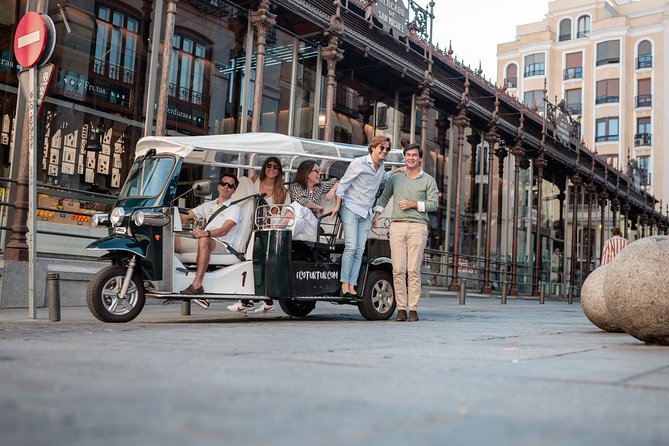
You’ll also pass by the Palace of the Spanish Courts, built on the site of a former convent that became the seat of Congress between 1834 and 1841. The stop includes the neoclassical facade details—like the porch with six Corinthian columns and the triangular pediment with reliefs.
There’s also a very specific story attached to the building’s entrance: the emblematic lions flanking the doorway were created from iron cast with captured cannons from the war in Africa. That’s the kind of detail that makes a quick glance turn into a real memory later.
Drawback to keep in mind: on a vehicle with limited roof height, you may not get the full facade angle you’d like. This is where the guide’s framing matters—listen for what they point out so you’re not left guessing what you’re seeing.
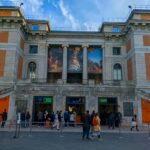
The city’s art center: Prado Museum without the maze
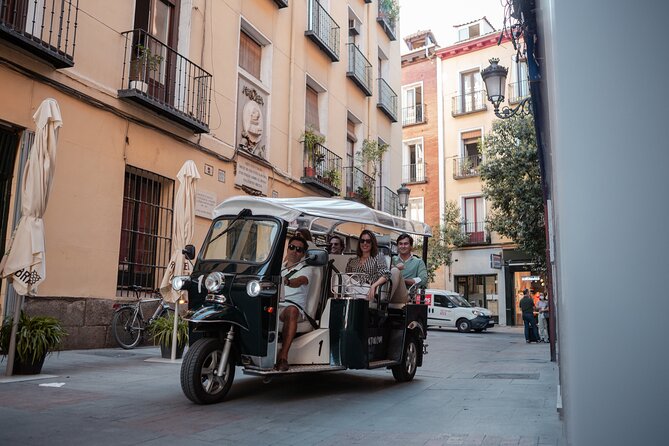
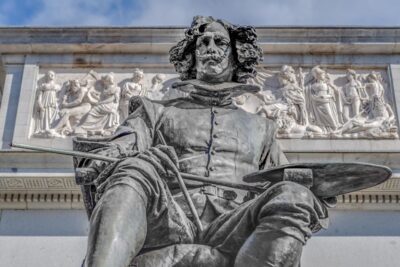
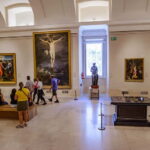
The tour includes a stop at the Prado Museum, described as one of the most important museums in the world for European painting, with a standout collection of artists like Velázquez, El Greco, Goya, Tiziano, Rubens, and El Bosco. The stop mentions that the Prado has extensive holdings and references names like Murillo, Ribera, Zurbarán, Fra Angelico, Rafael, Veronese, Tintoretto, Patinir, Antonio Moro, Van Dyck, and Poussin.
Even if you’re not entering the museum today, this is a key orientation stop. Once you see the museum area from the route, it becomes much easier to plan a visit later—especially if you’re trying to fit it into a short trip.
What to watch for: the tour gives pre-selected photo stops, and it can’t be modified for extra photography. If you want a deeper Prado experience, plan that as a separate visit.
San Jerónimo el Real: a Gothic-Renaissance church beside the Prado zone
Another stop is San Jerónimo el Real, often called Los Jerónimos. It’s a parish church with late Gothic structure and Renaissance influences from the early 1500s. The original building was remodeled and restored over centuries, but it still carries the royal connection: built by order of the Catholic Monarchs, used as spiritual retreat by several monarchs, and tied to royal ceremonies.
The highlight for visitors is that the church relates to Spain’s kings in a way that feels practical, not museum-like. You also get an architectural feature note: a large stairway leading to the door was built in 1906 for Alfonso XIII’s wedding.
On a tuk tuk tour, this kind of stop is best when you treat it as a “place-spotting” moment. If you’re curious, you can always come back later for more time.
Plaza of sports rivals: Cibeles and Neptune in the same breath
You’ll pass by Cibeles, the Roman goddess associated with land, agriculture, and fertility, and the square that holds her monumental fountain. It’s also tied to Madrid’s sports culture: the Real Madrid fan celebration is linked with Cibeles, while Atlético de Madrid’s fan celebrations are tied to Neptune.
The tour notes the original project where the sources faced each other and were later restructured and moved to occupy the centers of their respective squares. You’ll also see the sculptures described in detail: Cibeles carved in marble, lions carved by a French sculptor, and the goddess work attributed to Francisco Gutiérrez.
Why it’s fun on an express ride: it’s instantly recognizable, and it’s the kind of stop where you understand Madrid’s humor and identity—serious art and politics, then sports energy at street level.
Puerta de Alcalá: the grand neoclassical gate with a story
Another major stop is the monumental neoclassical triumphal-style door commissioned under Carlos III and inaugurated in 1778. The design is credited to Francesco Sabatini and described as a granite arc of triumph that the text notes was the first built in Europe after the fall of the Roman Empire—plus it’s called a precursor to structures like Paris’s Arc de Triomphe and Berlin’s Brandenburg Gate.
It’s also a special gate shape: the description notes five openings instead of the usual three. If you catch it at the right angle, it’s one of those Madrid sights that feels instantly “set in stone” yet still playful because of the scale and symmetry.
Practical tip: because the tour is on an open-top vehicle, don’t expect perfect high-angle shots of the upper parts. If you really want the pediment and upper reliefs, take a step back when stopped so you can adjust your perspective.
Banco de España: an exterior worth pausing for
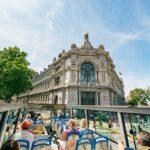
The route includes the Bank of Spain building, described as an awarded decorative project at the National Exhibition of Fine Arts in 1884. The interior is only visitable by groups connected to educational centers and universities, and exceptionally by certain nonprofit cultural or associative entities.
This makes the stop different from a typical monument stop. You might not go inside, but you still learn how Madrid built its institutions: a major seat for the issuance of coins and bills across Spain.
If your main goal is interiors, this one might feel limited. If your goal is the broader architectural “reading” of the city, it works well.
Plaza de Santa Ana: a classic square in the Cortes area
Next is Plaza de Santa Ana, in the Cortes neighborhood. It dates to 1810 and has gone through repeated urbanization changes. On a tour like this, the square is more about vibe and location than big-ticket architecture.
Use it as a mental waypoint. After this stop, it’s easier to imagine where you’d like to linger later—especially because Santa Ana tends to feel like a natural place to slow down.
Almudena Cathedral: a consecrated landmark with a museum inside
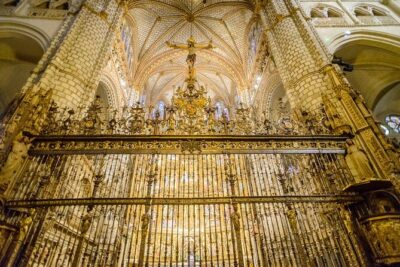
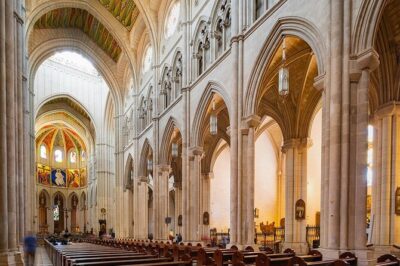
The route also includes the Almudena Cathedral, described as Madrid’s most important religious building. It was consecrated on June 15, 1993 by Pope John Paul II, and it was noted as the first consecrated cathedral outside Rome.
There’s also mention of the Almudena Cathedral Museum, with dozens of objects telling the story of the diocese of Madrid, spread across twelve rooms that cover items like mosaics and episcopal shields.
Why this matters on an express tour: it gives you a “later option.” If you decide you want the inside detail, you now know this isn’t just an exterior stop. If you don’t, it still anchors your mental map of the cathedral district.
Royal Palace area: the grand ending point you can photograph fast
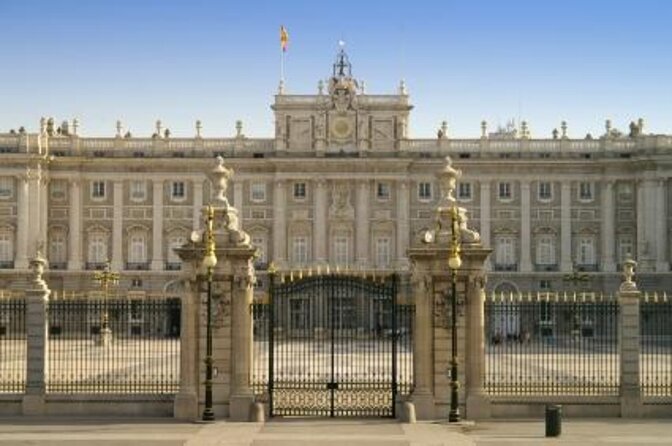
Your final sightseeing stop is tied to the Royal Palace, also called the Palacio de Oriente. The construction began in 1738, with works lasting seventeen years, and Carlos III established his habitual residence there in 1764. It’s surrounded by the Campo del Moro gardens and the Sabatini gardens—gardens that help frame the palace area.
Even when the tour doesn’t turn into a full palace visit, you’re getting the “orientation hit”: you see the palace zone, understand the scale, and get a good photo moment without the stress of queue planning.
Price and time: is $28.67 per person good value?
At $28.67 per person, the pricing feels fair when you focus on what you’re paying for:
- a private electric vehicle for your group
- a local guide in English
- a route that covers big-name landmarks in one go
- photo stops built into the plan
- no queues or waiting at the start
- blankets and weather protection in colder conditions
You’re not buying a slow, one-at-a-time crawl. You’re buying a city orientation tool that also sets you up for later deeper visits—Prado, the cathedral interior, and the palace area if you want to do more.
If you’re short on time (like your first day in Madrid) or your feet are already tired from arrival day, this is one of the more efficient ways to get the city’s main “story beats” without turning your schedule into chaos.
Comfort, safety, and the couple of things to plan for
The tuk tuk is designed to be suitable for older people, and drivers will help with getting on if needed. You’ll also see reminders that pets aren’t allowed, and babies aren’t allowed (minimum age two, with a minimum weight requirement of 9 kg).
Weather is handled with rain/wind layers and blankets. Still, the experience is outdoors and moving, so bring layers. One booking specifically called out that on colder days, the presence of protective side coverings mattered. Another booking pointed out that very hot days can be a problem. Translation: dress for comfort, not for looks alone.
And remember: the tour can’t be modified, and stops for photographs are fixed. You can’t ask for extra ad-lib stops mid-ride, even if your curiosity flares.
Should you book the Madrid Express Eco Tuk Tuk Tour?
If you’re doing Madrid as a first-timer, or you want a guided “highlight wiring” of the city without waiting, I think you should book it. The best fit is:
- one or two travelers who want the main sights fast
- families who want fun movement plus a guide who can explain things in clear English
- groups who don’t want to split up on buses and subways
Skip it if:
- you’re only interested in long museum or palace interiors today
- you’re very sensitive to heat or visibility angles from the vehicle roofline
- your schedule is extremely tight and you can’t risk the tour being shortened if you’re delayed
If you do book, treat the ride like a first draft of Madrid. Then pick your favorites for a return visit on foot later, when you can slow down and look up—without the tuk tuk doing the driving.
FAQ
How long is the Madrid Express Tuk Tuk tour?
It runs for about 1 to 4 hours, depending on the option you book.
Is the eco tuk tuk tour private?
Yes. It’s a private tour for your group only. If your group needs more than one vehicle, the pricing is set by how many tuk tuks are needed, with up to 4 passengers per tuk tuk.
What language is the tour guide speaking?
The tour is offered in English.
Are blankets provided for cold or rainy weather?
Yes. The experience includes blankets and protective layers against rain and wind to avoid getting cold weather discomfort.
Does it start with lines or waiting?
No. The tour starts without queues or waiting.
What happens if I cancel?
You can cancel for a full refund if you cancel up to 24 hours in advance. Changes within 24 hours aren’t accepted, and cancellations inside 24 hours aren’t refunded.
Can I modify the route or ask for additional photo stops?
The itinerary cannot be modified, and stops for photographs are prearranged. The route may still vary due to closed streets or demonstrations on the day.