REVIEW · MADRID
Madrid Welcome Tour with Local Guide in Eco Tuk Tuk Private
Book on Viator →Operated by Eco Tuk Tuk - Spain · Bookable on Viator
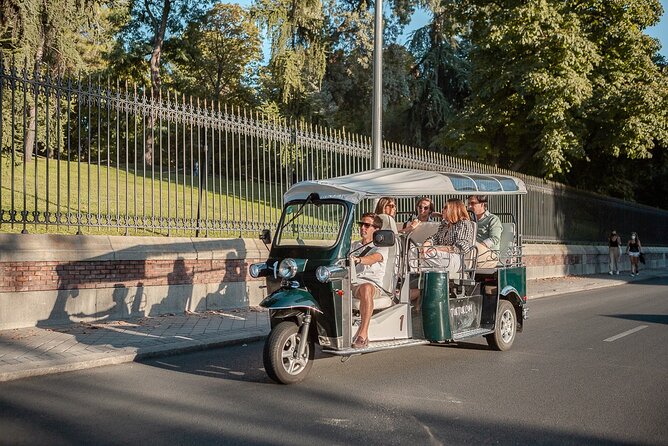
A tuk-tuk tour can save your Madrid days. This private ride strings together major landmarks across central Madrid—Royal Palace area, Atocha, Cibeles, the Prado corridor, and more—using an 100% electric eco tuk-tuk that keeps things light and fast. You get set photo stops and a local guide’s commentary, so you’re not just driving past pretty buildings.
I love two things most: it starts without queues or waiting, which matters when you only have a few hours, and the winter comfort is real with blankets and protective layers included. That combo turns “sightseeing” into an actual plan, not a shuffle of missed entrances and cold sidewalks.
One possible drawback: this is an overview, not a linger-and-browse tour. You’re on prearranged photo stops, so you can’t change the route or pause wherever you want, and fast pacing can feel like a sprint if you’re the slow-and-savor type.
In This Review
- Key things you’ll notice fast
- Why an Eco Tuk Tuk Works for Madrid in 1 to 4 Hours
- Start Under Plaza de Oriente: Finding the Puerta del Príncipe Meet-up
- That 1916 Covered Market Stop: Food, Delis, and Elegant Stroll Energy
- Royal Basilica of San Francisco the Great: A Palace-District Church Moment
- Atocha Railway Station: Madrid’s Busiest Hub and City Gateway
- Palace of the Spanish Courts: Lions, Congress History, and the Hall of Lost Steps
- Cibeles and Neptune Fountains: The Football Side of Mythology
- Prado Museum Corridor Stop: Why This Art Collection Pulls People Back
- Los Jerónimos (Saint Jerome el Real): Monastery Roots and a Royal Afterlife
- Puerta de Alcalá and the Independence Square Circle: Royal Gate Energy
- Banco de España Exterior: When the Grand Interior Isn’t for Everyone
- Plaza de Santa Ana + Almudena Cathedral: Old Urban Space Meets Modern Consecration
- Royal Palace of Madrid + Sabatini Gardens: State Ceremonies, Not Everyday Royal Life
- Optional Short Stop: Templo de Debod with Free Admission
- Comfort, Pace, and Photo Stops: What You’ll Really Experience
- Who Should Book This Welcome Tour (and Who Should Skip It)
- Should You Book This Madrid Welcome Tour by Eco Tuk Tuk?
- FAQ
- How long is the Madrid Welcome Tour?
- Is this a private tour?
- What language is the tour guide?
- Does the tour use an electric vehicle?
- Are blankets included for winter sightseeing?
- Where does the tour start and end?
- Is Temple of Debod included, and is it free?
- Can I request changes to the route or extra photo stops?
- Are pets allowed on the tour?
- Should You Book This Madrid Welcome Tour by Eco Tuk Tuk?
Key things you’ll notice fast
- Electric + private = an easy, low-fuss way to cover Madrid without switching transport or cramming in walking
- Blankets are provided for winter rides, so you stay comfortable longer
- Photo-stop planning keeps the tour moving, but it also limits free time at each stop
- The guide-driven route hits major anchors like Royal Palace area, Atocha, Cibeles, Prado sights, and Jerónimos
- Recent feedback is consistently strong (4.8 rating, recommended by 96%), with people praising clear directions and friendly guide energy
Why an Eco Tuk Tuk Works for Madrid in 1 to 4 Hours
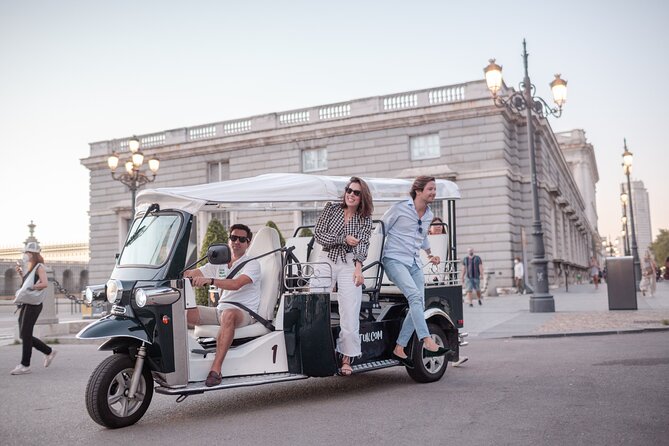
Madrid is a big city with a lot of “wow” concentrated in the center. This Madrid Welcome Tour is built for that reality: you get a guided overview that links top sights in a short window, rather than spending your limited time figuring out logistics.
The electric tuk-tuk also changes the feel of the day. You’re higher up than on a bus, closer to the street scene, and—because it’s designed for this kind of touring—you can ask questions as you go. I like that the tour starts without queues or waiting, since that’s often where half-day plans get wrecked.
The value is not just the vehicle. It’s the mix of big-name stops (Royal Palace area, Almudena Cathedral, Prado corridor) plus practical “read the city” anchors like Atocha Station and Cibeles, which help you orient for the rest of your trip.
You can also read our reviews of more guided tours in Madrid
Start Under Plaza de Oriente: Finding the Puerta del Príncipe Meet-up
This tour begins at C. de Bailén, 4, Centro, right by the Royal Palace area. The key detail: the pickup is in the bus station (underground) by Plaza de Oriente, near the Puerta del Príncipe landmark.
If you’re arriving late or worried about getting lost, use the directions the operator gives: search Calle Bailén 4 or Puerta del Príncipe in Google Maps. You’ll see stairs leading into the station area and Eco Tuk Tuk signage once you’re in the right spot.
If you have mobility needs, the tour notes that you can contact them for help accessing the meeting point via elevator—so don’t guess. Message them early so the start is smooth.
That 1916 Covered Market Stop: Food, Delis, and Elegant Stroll Energy
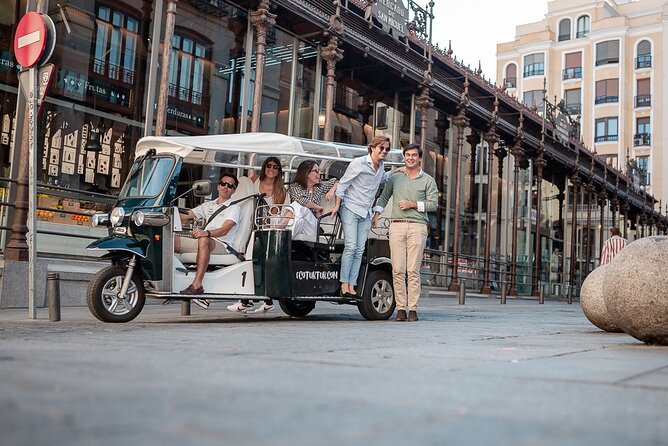
One of the stops is a covered market built around 1916, known for local food, delis, and events in an elegant setting. This is a smart inclusion for an overview tour because it gives you a quick taste of how locals move through the city: not only museums and palaces, but daily life.
You won’t have time to turn this into a full food crawl. Still, it’s a great photo moment and a useful starting reference point for where you might want to return later for snacks, ingredients, or a calmer look around.
If you’re traveling with kids or anyone who hates long museum lines, a market stop can be a morale boost. It breaks up the heavy-hitter monuments with something more human and immediate.
Royal Basilica of San Francisco the Great: A Palace-District Church Moment
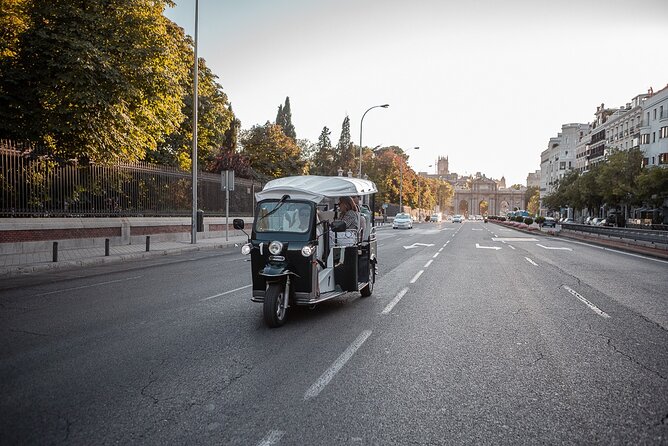
The route includes the Royal Basilica of San Francisco the Great, officially the Basilica of Our Lady of the Angels, located in Madrid’s Palace district within the historic center.
This stop is mainly about context and vibe. Even if you don’t go inside, it’s the kind of landmark that helps you understand how Madrid grew around religious and political power centers. It also gives you a break from purely royal-world sights like the palace and courts.
Because this is a photo-stop tour, plan to treat it as a “see it, orient it, remember it” moment. If you want deep time inside, you’ll need a separate plan.
Atocha Railway Station: Madrid’s Busiest Hub and City Gateway
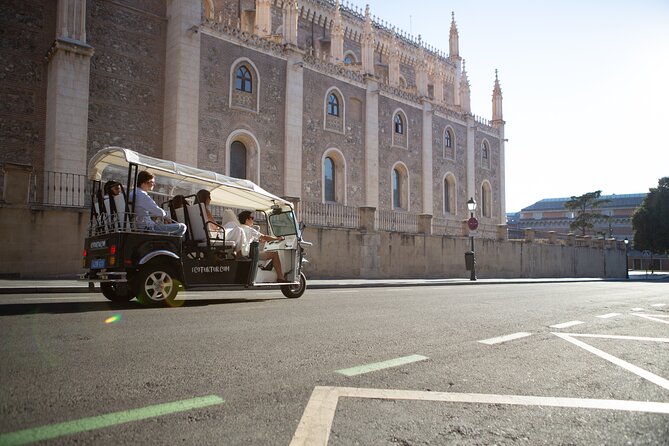
Atocha is one of those places that feels like a city within the city. The tour passes the Atocha railway station complex near Emperor Charles V Square, and it’s described as the busiest passenger station in Spain and one of the main ones in Europe.
Why include it on a welcome tour? Because it’s a practical landmark. After your tuk-tuk ride, you’ll have a mental map of where one of the biggest transit arteries is, which makes it easier to plan day trips and understand the flow of neighborhoods.
It’s also a good “anchor” stop for first-time visitors. You can’t miss its importance, and it helps you mentally connect the city’s monuments with real movement—commuters, visitors, departures, arrivals.
You can also read our reviews of more private tours in Madrid





Palace of the Spanish Courts: Lions, Congress History, and the Hall of Lost Steps

The Palace of the Spanish Courts is a major storyline stop. It was erected on the site of a former convent used as the seat of Congress between 1834 and 1841, so you’re looking at a building layered with political shifts.
On the facade, the details are the headline:
- A neoclassical portico with six Corinthian columns
- A triangular pediment decorated with reliefs by Pontian Ponzano
- Iconic lions flanking the entrance, cast with iron from cannons captured in the African war
The building’s bronze door only opens on very marked occasions, so think of this as an exterior and architecture moment. Inside, the tour notes the famous Session Hall and a library/conference hall known as the hall of the lost steps.
This is one of those stops where a quick guide explanation turns stonework into story. If you like symbolism—power, nation-building, propaganda through art—this stop will land.
Cibeles and Neptune Fountains: The Football Side of Mythology
Madrid’s public squares can be surprisingly personal. Cibeles and Neptune are framed through Greek mythology and through modern sports culture: fans of Atletico Madrid gather at the square tied to Neptune, while Real Madrid fans celebrate at Cibeles.
The fountains also have a neat urban-planning history. They were originally facing each other along Paseo del Prado, then underwent restructuring and relocation at the end of the 19th century, eventually settling in the centers of the Plaza de Cibeles and Canovas del Castillo squares.
Look for the Cybele details: the fountain depicts the Roman goddess Cybele, symbol of land, agriculture, and fertility, on a cart drawn by two lions in the myth (linked to Hippomenes and Atalanta in the explanation provided). The sculpture work credits Francisco Gutierrez and Roberto Michel for the lions.
Even if you’re not a football person, you’ll get a better sense of how Madrid uses public art to build identity.
Prado Museum Corridor Stop: Why This Art Collection Pulls People Back

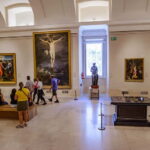
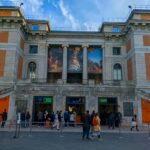
The tour includes a Prado-related stop, described with serious weight: art historian Jonathan Brown is quoted saying it’s the most important museum in the world for European painting.
The highlight list is the kind you’d circle on a bucket list:
- Velázquez
- El Greco
- Goya (with the most extensive representation)
- Titian
- Rubens
- Bosch
And additional major names across centuries like Murillo, Ribera, Zurbarán, Fra Angelico, Rafael, Veronese, Tintoretto, Patinir, Van Dyck, and Poussin.
This is not the time for a full museum visit. It’s the time to get the emotional map: you see the scale of what’s here, learn what the museum is known for, then decide if you want to spend your own longer day inside.
If you’re an art lover, I’d treat this stop as your planning session. If you’re not, it still helps to have at least one world-class art destination placed on your itinerary before the rest of the week gets planned.
Los Jerónimos (Saint Jerome el Real): Monastery Roots and a Royal Afterlife
The tour stops at the ancient monastery of Saint Jerome el Real, popularly called Los Jerónimos. It was governed by the Order of Saint Jerome, and next to it existed a Royal Room that was expanded into the Palace of the Good Retreat during the time of Philip IV.
This kind of stop is about time travel—how Madrid’s religious institutions can transform into royal functions and political symbolism. Even with limited time, you’ll come away with a clearer picture of why the city looks the way it does: stone, authority, faith, and power all in the same neighborhoods.
It’s also a relief stop if your day is starting to feel too palace-and-flag heavy. A monastery area changes the pace visually and spiritually.
Puerta de Alcalá and the Independence Square Circle: Royal Gate Energy
Another major anchor is Puerta de Alcalá, one of Madrid’s five old royal gates that gave access to the city. It sits in the middle of the Independence Square roundabout, which makes it easy to spot from multiple angles.
The tour also frames what surrounds it, and that context helps you “read” the street:
- Palacio de Buenavista (Army Headquarters)
- Palacio de Linares (House of America)
- Palacio de Comunicaciones (formerly post office; now Madrid City Council)
- Banco de España
If you like architecture, this is a satisfying stop because you’re seeing how different institutions share the same city space—gateways, government, finance, and civic offices all within a tight visual radius.
Banco de España Exterior: When the Grand Interior Isn’t for Everyone
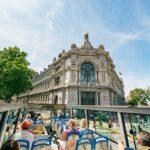
You’ll also pass the Banco de España building, described as a “decorative waste” that received an award at the National Exhibition of Fine Arts of 1884. The building was created as a headquarters aligned with the National Bank’s role in issuing coins and banknotes across Spain.
Here’s the practical note: the tour information says the interior can only be visited by groups of educational establishments and universities, with exceptional access for certain cultural entities and non-profit associations.
So if you’re hoping for an easy spontaneous interior visit during the tuk-tuk stop, you should set expectations accordingly. Treat it as exterior architecture and city context, then plan a separate visit only if you fall into a category that can access it.
Plaza de Santa Ana + Almudena Cathedral: Old Urban Space Meets Modern Consecration
The route includes Plaza de Santa Ana, an open space in the Cortes district dating back to 1810, with repeated urbanization changes over time.
Then comes Almudena Cathedral, described as the most important religious building in Madrid. It was consecrated on June 15, 1993 by Pope John Paul II, noted as the first cathedral consecrated outside Rome.
The cathedral museum is part of the story too, with dozens of objects across twelve rooms, covering items like mosaics and episcopal shields—so you get a sense of how Madrid’s diocese history is preserved and displayed.
If you want a “feels like Madrid” stop that isn’t just another monument, this pairing works. The plaza gives you street-level life; the cathedral gives you a clear spiritual landmark.
Royal Palace of Madrid + Sabatini Gardens: State Ceremonies, Not Everyday Royal Life
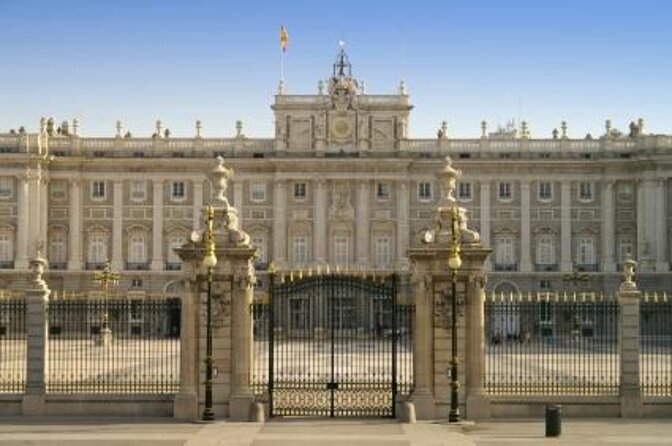
The tour takes in the Royal Palace of Madrid, also called the Royal Palace of the East. It’s the official residence of the King of Spain, but the current kings don’t live there—so it’s used for state ceremonies and solemn acts.
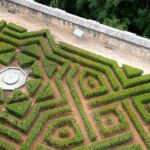
Right across from the northern facade you’ll find the Sabatini Gardens, spanning 2.66 hectares between Bailén Street and the San Vicente Coast. This is a helpful stop when your eyes need green breathing room after palace facades and big ceremonial architecture.
Even if you’re not touring the palace interior, the palace exterior + the gardens combo helps you understand how Madrid designs space for power and pageantry.
Optional Short Stop: Templo de Debod with Free Admission
Depending on your timing and routing, you may also get a quick look at Templo de Debod, an ancient Egyptian building relocated to Madrid. It’s located west of the Spanish Steps next to Paseo del Pintor Rosales, on a high where the Mountain Barracks was located.
The stop is listed as 10 minutes and admission ticket free. That makes it a nice add-on when you want one truly different cultural flavor without spending a whole extra half-day.
Plan to treat it as a photo-and-remember stop. If you want more time, you’ll likely be doing it on your own afterward.
Comfort, Pace, and Photo Stops: What You’ll Really Experience
The tuk-tuk experience is designed for short, high-value sightseeing. The tour includes pre-selected stops for photographing and notes you can’t request changes to the route or photo stops, which keeps timing predictable.
It also runs in rain or heat, only canceling under extreme conditions. The good part for comfort: blankets and protective layers are included, and the vehicles are suitable for older people with driver help getting on if needed.
The “pace” is something to watch. One-hour versions tend to be a quick lap. The longer versions add more time, but you still shouldn’t expect museum-depth stops at every location. Think of it as a guided orientation—then you choose what deserves your time later.
On cold days, I’d plan your clothing around the ride even before you plan your sightseeing. Blankets help, but you’ll still be outside looking at major landmarks for short photo moments.
Who Should Book This Welcome Tour (and Who Should Skip It)
This is perfect if:
- You’re on your first Madrid trip and want a fast overview to set your bearings
- You want less walking and more “ride and learn”
- You like photo stops that help you decide what to revisit
- You travel with older family members who benefit from easier access onto a vehicle
Skip it (or pair it carefully) if:
- You want long, flexible time inside museums and churches
- You hate a schedule that doesn’t let you drift off-script
- You’re traveling with very young kids, since the minimum age is two years, and the tour lists a minimum weight of 9 kg
Should You Book This Madrid Welcome Tour by Eco Tuk Tuk?
If you’re deciding whether to do this as your first day move, my take is simple: book it if you value orientation + efficiency + comfort. The tour hits major landmarks across the city in a way that helps you plan the rest of your trip with more confidence.
It’s also a strong “value-per-hour” choice. At $28.66 per person for a guided electric private ride with included blankets and a no-queue start, you’re paying for time saved and for a local guide’s way of connecting the dots—especially helpful when Madrid’s highlights feel scattered on your first map.
One last practical point: choose the duration that matches your energy. If you want more than a quick hit, go longer. If you just need a first-day orientation, even the shorter versions can do the job.
FAQ
How long is the Madrid Welcome Tour?
The tour lasts about 1 to 4 hours, depending on the option you book.
Is this a private tour?
Yes. It’s private, and only your group participates.
What language is the tour guide?
The tour is offered in English.
Does the tour use an electric vehicle?
Yes. The tour vehicle is listed as 100% electric and sustainable.
Are blankets included for winter sightseeing?
Yes. Blankets and protective layers are included to help with cold weather.
Where does the tour start and end?
It starts at C. de Bailén, 4, Centro, 28013 Madrid, and ends back at the same meeting point.
Is Temple of Debod included, and is it free?
Templo de Debod is listed as a stop with free admission ticket information, and the stop time is listed as 10 minutes.
Can I request changes to the route or extra photo stops?
No. The itinerary may vary by closed streets or demonstrations, but the tour notes that stops for photographs can’t be modified and are made in prearranged places.
Are pets allowed on the tour?
No. Pets are not allowed for security reasons.
Should You Book This Madrid Welcome Tour by Eco Tuk Tuk?
If you want the easiest first-day win in Madrid, this is one of the cleaner choices: electric comfort, included winter gear, and a route that hits the landmarks you’ll need for the rest of your planning. If your goal is deep time inside specific sights, you’ll still need separate visits—but as an efficient guided overview, this one makes a lot of sense.