REVIEW · MADRID
Christmas Lights Tour of Madrid in Eco Tuk Tuk Private
Book on Viator →Operated by Eco Tuk Tuk - Spain · Bookable on Viator
Madrid by night from a tuk-tuk feels unreal. This private, English-language eco tuk-tuk ride strings together big-hitter landmarks and holiday-lit streets in under an hour, with photo stops planned along the way.
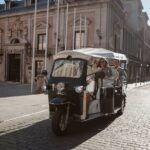
Two things I really like: the 100% electric vehicle keeps it smooth (and low-fuss) in busy central streets, and the winter setup is genuinely useful, with protective layers plus blankets when it gets cold. You also get pre-selected stops so you’re not hunting for the good angles yourself.
One possible drawback: the route is fixed, and traffic or holiday conditions can affect how much you see. On a day like Christmas, some displays may not be on, so manage expectations if you’re aiming for maximum lights.
In This Review
- Key highlights to know before you go
- Start at Retiro: how the private tuk-tuk night sets you up
- Electric and winter-proof: comfort for Christmas nights
- The 59-minute Christmas lights route, stop by stop
- Puerta de Alcalá: the Carlos III gate lit up like a landmark should be
- Salamanca streets: Velázquez, Ortega y Gasset, Serrano
- Plaza de Colón: Columbus, the fountains, and the sculptural drama
- National Library of Spain (BNE): millions of books and a museum feeling
- Plaza de Cibeles: goddess, lions, and Real Madrid symbolism
- Palacio de Cibeles: postcard-worthy architecture with old-world purpose
- Bank of Spain exterior: that grand building you can’t tour inside
- Plaza de Canalejas: between San Jerónimo and Calle de la Cruz
- Palacio de las Cortes: neoclassical columns and symbolic lions
- The Paseo del Prado fountains story: Cibeles and Neptuno in competition
- Prado Museum area: the art-world weight of Velázquez, Goya, and more
- San Jerónimo el Real (Los Jerónimos): the late Gothic church behind the art
- Price and time value: does $47.77 make sense?
- Who should book this, and who might walk instead
- Should you book this Madrid Christmas Lights Eco Tuk-Tuk tour?
- FAQ
- How long is the Christmas Lights Tour of Madrid in Eco Tuk Tuk Private?
- Is this tour private?
- What language is the tour offered in?
- Does the tour include blankets or weather protection?
- Where is the meeting point?
- Is hotel pickup or drop-off included?
- What type of vehicle is used?
- Are there age or weight limits?
- Are pets allowed?
Key highlights to know before you go
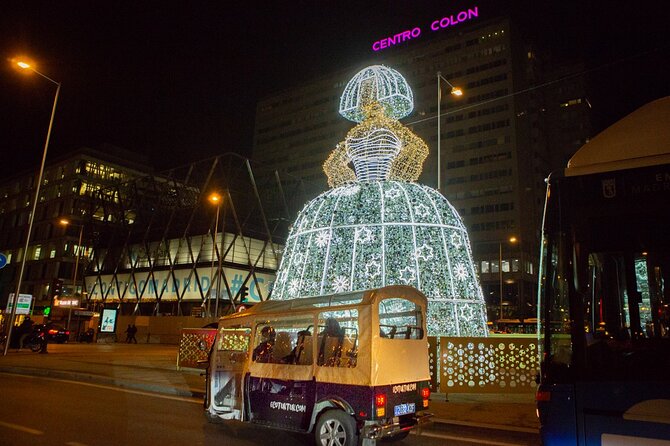
- 100% electric eco tuk-tuks that keep the ride quiet and comfortable through central Madrid
- Blankets and rain/wind protection in winter, so the cold doesn’t ruin your photos
- Private vehicle for your group (only your party is in the tuk-tuk)
- Pre-set photographing stops you can use without negotiating the schedule
- A tight sampler of Madrid’s most important squares and buildings in about 59 minutes
- English-speaking guides who have been praised for friendly storytelling and navigating quickly
Start at Retiro: how the private tuk-tuk night sets you up
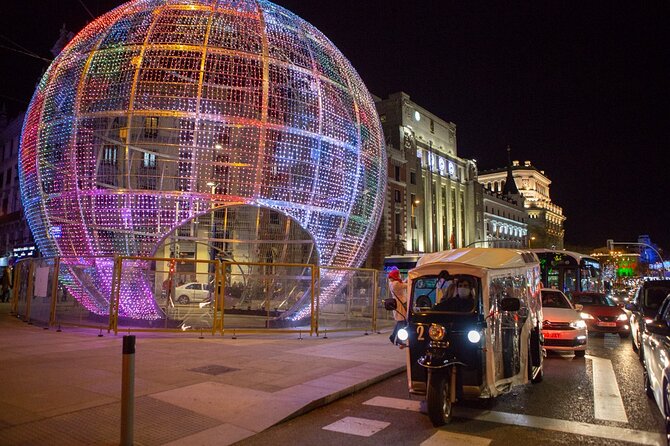
Your tour starts at C. de Antonio Maura, 13 (Retiro), and you end right back at the same place. That matters more than you’d think. Madrid’s center can get chaotic in the evening, so starting and finishing in one spot helps you avoid the “now what” feeling that hits when you’re done.
Because it’s private, you’re not sharing the ride with a random mix of strangers. The tuk-tuks are booked based on your group size (up to the legal limit per vehicle), and that means you can actually hear the guide over the street noise. You also feel more relaxed asking questions as you go, especially when the guide is pointing out details you’d usually miss from the sidewalk.
You can also read our reviews of more private tours in Madrid
Electric and winter-proof: comfort for Christmas nights
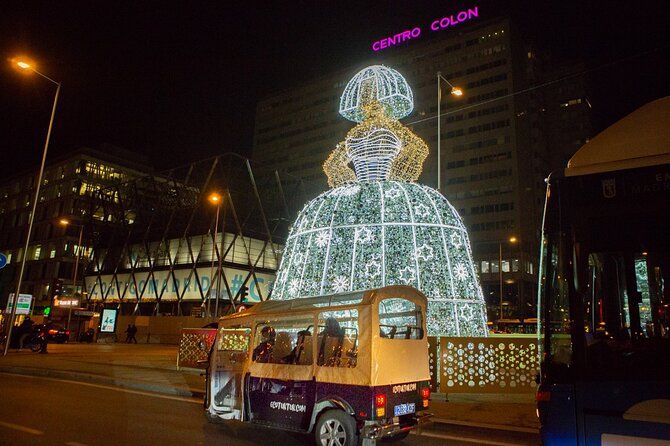
The big practical win here is comfort. The vehicles are 100% electric and sustainable, and in winter the tuk-tuks come with protective layers against rain and wind, plus blankets to keep you warm. That’s not a gimmick. Madrid winters can bite, and a 59-minute ride still feels long if you’re shivering.
Most people can join, but there are limits. The minimum age is two years, and babies aren’t allowed. There’s also a minimum weight of 9 kg. If you’re traveling with a small child, it’s worth double-checking that before you plan your evening.
Also keep in mind what you’re not allowed to bring: pets and companion animals aren’t permitted for security reasons. Service animals are allowed.
The 59-minute Christmas lights route, stop by stop
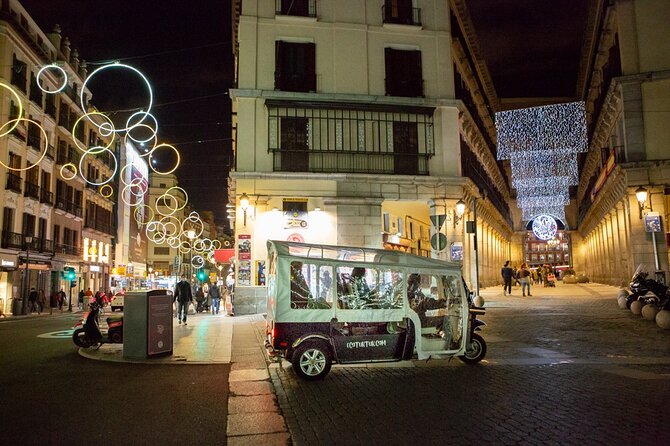
This tour is built like a best-of drive through central Madrid—squares, monuments, and major streets—so you see a lot without walking miles. The twist is that you’re pairing classic Madrid landmarks with holiday mood, which makes the city feel extra theatrical.
You’ll be doing pre-selected photo stops (the plan is fixed), so I suggest planning like a photographer: phones charged, one lens/zoom setting ready, and your gloves or mittens accessible so you can grab a shot without fumbling.
Puerta de Alcalá: the Carlos III gate lit up like a landmark should be
You’ll first see a monumental gate built by order of Carlos III to replace an older 16th-century one, inaugurated in 1778. It’s one of those places that looks grand even in daylight, and at night it turns into a natural focal point for holiday photos.
If you’re the type who likes context, this is a great starting stop because it anchors the whole evening in Madrid’s architectural story, not just decorations.
Salamanca streets: Velázquez, Ortega y Gasset, Serrano
Then you head through the Salamanca neighborhood’s main streets: Velázquez, Ortega y Gasset, and Serrano. This is where Madrid’s holiday energy often feels more upscale and polished, and where you can spot how Christmas lighting changes the vibe of broad avenues.
This stretch is a good moment to sit back, enjoy the windows/streetscape views, and let the guide connect what you’re seeing to what the neighborhood is known for.
You can also read our reviews of more tours and experiences in Madrid
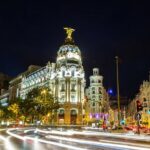
Plaza de Colón: Columbus, the fountains, and the sculptural drama
Next is the Christopher Columbus monument presiding over the square. It’s a neogothic white marble sculpture with an imposing stone pedestal. Built in 1885 by Jerónimo Suñol, it was created for the celebration of the wedding between Alfonso XII and María de las Mercedes de Orleans.
Around it, the Discovery Gardens were inaugurated in 1970, and you can admire sculptures there—including a monument dedicated to the discovery of America. Beneath the area sits the Cultural Center of the Villa Fernán Gómez.
Why this stop works for a Christmas lights tour: the square layout helps you see both buildings and open space, so the lighting feels less cluttered and more “designed.”
National Library of Spain (BNE): millions of books and a museum feeling
You’ll also pass the National Library of Spain (BNE), an autonomous body that preserves Spain’s bibliographic and documentary heritage. It holds around 30 million publications from the early 18th century onward: books, magazines, maps, engravings, drawings, scores, and brochures.
The Library Museum and exhibition rooms share that material with visitors, but the key point for you on this tour is simpler: this is a major Madrid institution, and the exterior/area gives you a different mood than shopping streets and sports squares.
Plaza de Cibeles: goddess, lions, and Real Madrid symbolism
Then you arrive at Plaza de Cibeles, where the centerpiece is the Roman goddess Cibeles on a chariot pulled by two lions. The mythological riders are Hipómenes and Atalanta. The goddess is sculpted in marble by Francisco Gutiérrez, while the lions were carved by Roberto Michel.
It’s also a sports icon: Cibeles is where Real Madrid titles are celebrated, plus successes of the Spanish national team. So even if you’re not a football person, you’ll feel the cultural importance when you’re standing near it.
Palacio de Cibeles: postcard-worthy architecture with old-world purpose
Cibeles isn’t just a fountain stop. You’ll also see Palacio de Cibeles, the former headquarters of the Spanish Post and Telegraph Society, inaugurated in 1909. It was designed by Antonio Palacios and Joaquín Otamendi, and in 1993 it was declared a Site of Cultural Interest.
What to look for: the building uses stone, iron, and glass, and it was meant to express a union of tradition and modernity. That mix looks especially striking when lit up at night, because the edges and materials catch light differently than they do in daylight.
Bank of Spain exterior: that grand building you can’t tour inside
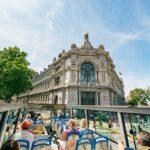
Next is the Bank of Spain building. The description is blunt and a little funny in its own way: it’s sometimes called a “decorative waste,” and it was awarded at the National Exhibition of Fine Arts in 1884. It was built to match the importance of the bank’s role in issuing coins and bills for Spain.
Important practical note: the interior can only be visited by groups from educational centers and universities, with exceptional access also for cultural and non-profit associations. On your tuk-tuk tour, you’re here for the night views and the architectural statement.
Plaza de Canalejas: between San Jerónimo and Calle de la Cruz
You’ll pass Plaza de Canalejas, formerly known as the Four Streets, in the Centro district. It sits between Carrera de San Jerónimo and Calle de la Cruz (and near Sevilla and Príncipe).
This stop is less about museums and more about getting the feeling of central Madrid’s tight street network, especially when Christmas lighting makes the area feel festive rather than frantic.
Palacio de las Cortes: neoclassical columns and symbolic lions
The Palace of the Spanish Cortes comes next. It was built on the site of the old convent of the Holy Spirit, which served as the Congress headquarters between 1834 and 1841.
On the main façade, you’ll see a neoclassical portico with six fluted Corinthian columns, plus a triangular pediment decorated with reliefs by Ponciano Ponzano. The lions flanking the entrance were made by the same sculptor and were cast from iron from cannons captured during the African War. Under the pediment is a bronze door that only opens on very special occasions.
Even if you never step inside, this is a dramatic exterior stop. At night, you’ll notice how the symmetry and stonework look more formal and heavier—very “Madrid government” energy.
The Paseo del Prado fountains story: Cibeles and Neptuno in competition
You’ll also get a quick myth-and-music-style explanation of the two fountain icons: Cibeles and the fountain associated with Neptuno. In the original project by Ventura Rodríguez, both fountains faced each other along the Paseo del Prado. Later, near the end of the 19th century, they were restructured and moved so they sit in the center of Cibeles and Cánovas del Castillo squares.
Sports fans attach meaning here too: Atlético de Madrid celebrates victories at Plaza del Dios del Mar, while Real Madrid celebrates at Cibeles.
This stop works well during a lights tour because it gives you a narrative thread. You’re not just seeing objects—you’re seeing how Madrid “labels” spaces with stories.
Prado Museum area: the art-world weight of Velázquez, Goya, and more
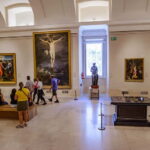
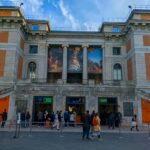
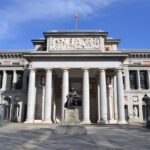
You’ll pass the Prado Museum area, where the art stakes are sky-high. Art historian Jonathan Brown has described it as the world’s most important museum for European painting.
The big names you’ll hear tied to the collections include Velázquez, el Greco, Goya, Titian, Rubens, and Bosch, with Goya especially well represented. You’ll also hear about major groups of works by Murillo, Ribera, Zurbarán, Fra Angélico, Rafael, Veronese, Tintoretto, Patinir, Antonio Moro, Van Dyck, and Poussin.
You won’t be touring gallery rooms in this short ride, but that’s why the timing works. You get the location, the landmark framing, and the context, so later—if you want—you know exactly what to target.
San Jerónimo el Real (Los Jerónimos): the late Gothic church behind the art
Finally, you’ll see San Jerónimo el Real, popularly known as Los Jerónimos. It’s a late Gothic parish church with Renaissance influences from the early 16th century. The original building was remodeled and restored many times over the centuries, so it’s not a single unbroken “time capsule.”
Its royal connection is strong: built by order of the Catholic Monarchs, used as a spiritual retreat, and even involved in royal investitures in the absence of a cathedral. The wedding of Alfonso XIII was also celebrated here, and the great staircase leading to the door was built in 1906.
This church stop gives your night tour a quieter, reflective tone. Christmas lights are fun, but you also get that Madrid “soul” feeling—stone, faith, and ceremony.
Price and time value: does $47.77 make sense?
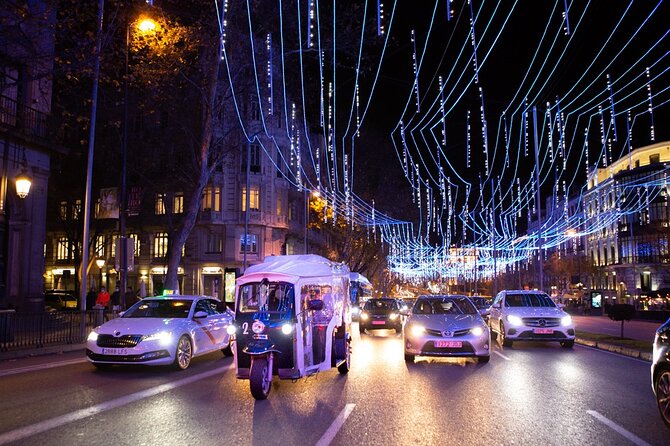
At $47.77 per person for about 59 minutes, this isn’t a budget “see-everything” deal. It’s a concentrated experience. You’re paying for three things you can’t replicate easily on your own without planning: a private electric tuk-tuk, planned photo stops, and expert narration that keeps moving.
For me, the value clicks if you’re:
- short on time in Madrid
- traveling with kids or anyone who doesn’t want to walk a long route
- arriving in the afternoon and want a fast orientation to central landmarks
- visiting in winter and want an evening plan that stays comfortable
If you’re the type who enjoys slow wandering and you know the neighborhoods well, you might feel you could do it on foot. And one caution from real-world experience: if some major holiday nights aren’t fully lit (Christmas Day can be like that), the “wow” factor drops. Still, the drive-through context of squares and monuments keeps it interesting even when the lights are muted.
Who should book this, and who might walk instead
This is best for:
- families who want an easy intro to central Madrid
- first-timers who want landmark context without a full-day plan
- travelers who don’t want to wrestle with traffic or parking
- anyone who appreciates historical details tied to places, not just decoration
It may be less ideal if you:
- hate fixed routes and want total freedom to stop anywhere
- expect the tour to feel like a long walking crawl of every lit street
- are very sensitive to the physical design of the vehicle while viewing outward from the ride
One more practical tip: because the ride is short, dress for the weather and treat your first photo stop like a bonus, not a guarantee. You’ll be moving, so you’ll want quick decisions.
Should you book this Madrid Christmas Lights Eco Tuk-Tuk tour?
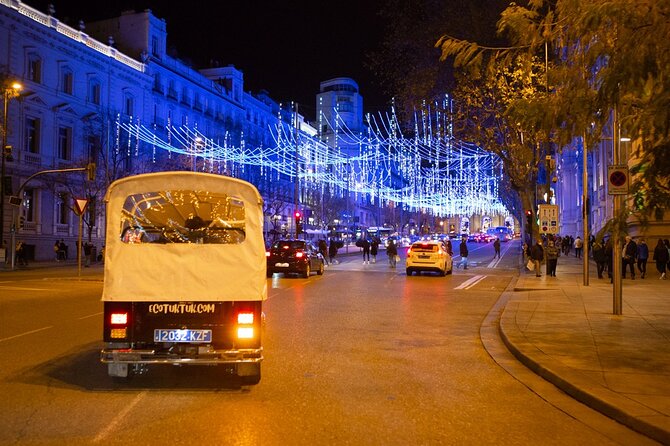
I’d book it if you want a high-comfort, efficient holiday evening that mixes major Madrid monuments with the seasonal lighting vibe. The combination of electric tuk-tuks, winter blankets, and pre-set photo stops is exactly the kind of convenience that makes a short trip feel complete.
Skip it (or consider walking) if your priority is sheer light volume and you’re hoping for hours of wandering. This tour is a “best of the illuminated landmarks” kind of experience, not a full-night festival circuit.
FAQ
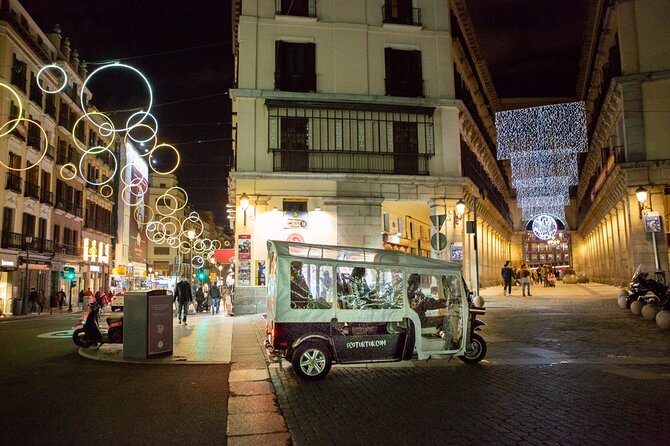
How long is the Christmas Lights Tour of Madrid in Eco Tuk Tuk Private?
It runs for about 59 minutes.
Is this tour private?
Yes. It is a private tour/activity, and only your group participates. The tuk-tuk is booked for your group only.
What language is the tour offered in?
The tour is offered in English.
Does the tour include blankets or weather protection?
In winter, the tuk-tuks have protective layers against rain and wind and blankets to keep you warm.
Where is the meeting point?
The meeting point is C. de Antonio Maura, 13, Retiro, 28014 Madrid, Spain.
Is hotel pickup or drop-off included?
No. Hotel pickup and drop-off are not included.
What type of vehicle is used?
It uses a 100% electric and sustainable vehicle.
Are there age or weight limits?
Minimum age is two (2) years. There is also a minimum weight requirement of 9 kg, and babies aren’t allowed.
Are pets allowed?
Pets and companion animals are not allowed for security reasons. Service animals are allowed.