REVIEW · MADRID
Madrid Expert Plus Tour with Local Guide in Eco Tuk Tuk Private
Book on Viator →Operated by Eco Tuk Tuk - Spain · Bookable on Viator
Madrid clicks into focus in an eco tuk tuk.
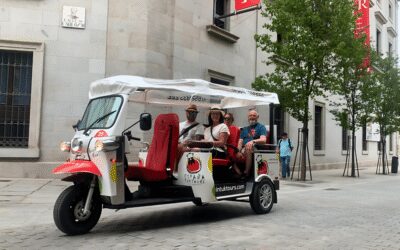
I like that it starts fast with a no-queue pickup feel and a private eco tuk tuk setup where your group has the ride to itself.
You’ll also love how the guide turns big sights into something you actually understand. Names I’ve seen come through often include Christian and Lucia, and their style is practical: what you’re looking at, why it matters, and quick tips to make the day easier. One thing to keep in mind: the route and photo stops are pre-set, so you can’t freestyle detours whenever you feel like it.
In This Review
- Key things to know before you roll
- Riding Madrid like locals do: private electric tuk tuks, real guide time
- The 2 to 4 hour plan: how the pacing really feels
- Where you start: the Puerta del Príncipe meeting point
- Stop-by-stop Madrid: what each landmark teaches you to notice
- Mercado and Atocha: food culture plus Spain’s busiest rail hub
- Palacio de las Cortes and the Neptune Fountain: power, design, and public space
- Prado Museum area and San Jerónimo el Real: why Madrid is serious about art
- The Plaza Santa Ana moment: a neighborhood square with a timeline
- Churches with big meaning: San Francisco el Grande and Almudena Cathedral
- Royal Palace and Campo del Moro: where Madrid flexes royal power
- Templo de Debod: an Egypt-to-Madrid contrast that feels oddly perfect
- Puerta de Alcalá: neoclassical triumphal arch with five openings
- Las Ventas bullring and the big sports streets: Madrid’s public drama
- Columbus monument and Discovery Gardens: a photo-friendly science of wonder
- National Library of Spain and the grand financial facades
- Cibeles fountain and Banco de España: what the city celebrates
- Value check: is the $28.67 per person price fair for what you get?
- Who should book this eco tuk tuk tour?
- Should you book this eco tuk tuk tour of Madrid?
- FAQ
- How long is the Madrid Expert Plus Tour?
- Is this tour private?
- What language is the tour offered in?
- Do you provide protection for cold or rain?
- Where is the meeting point?
- Are pets allowed and is there a minimum age or weight requirement?
Key things to know before you roll
- Electric and eco-friendly comfort: A 100% electric, sustainable tuk tuk with weather protection.
- A guide who connects the dots: History and culture tied directly to the landmarks you see.
- No-queue start style: Designed to help you get moving instead of waiting around.
- Winter and rain gear: Blankets in winter, plus protective layers against cold wind and weather.
- Photo timing is planned: Stops for photos happen at scheduled points, not on demand.
- A lot packed into 2 to 4 hours: Best for first-timers and time-crunched trips.
Riding Madrid like locals do: private electric tuk tuks, real guide time
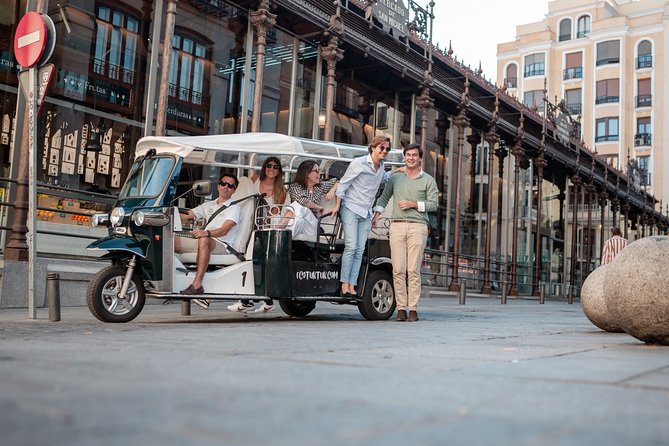
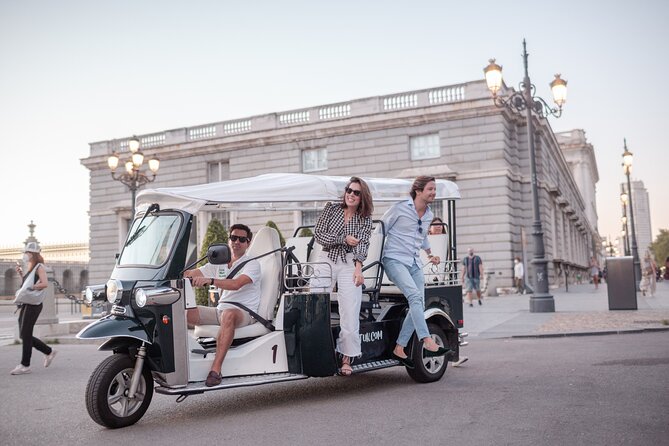
Madrid can feel like a puzzle when you’re dropped in the middle of it. This tour fixes that in a simple way: you’re carried through key areas without the stress of parking, zigzagging between transit lines, or constant walking. Since it’s private, it’s also calmer. No herd energy, no waiting for the slow person at the next corner.
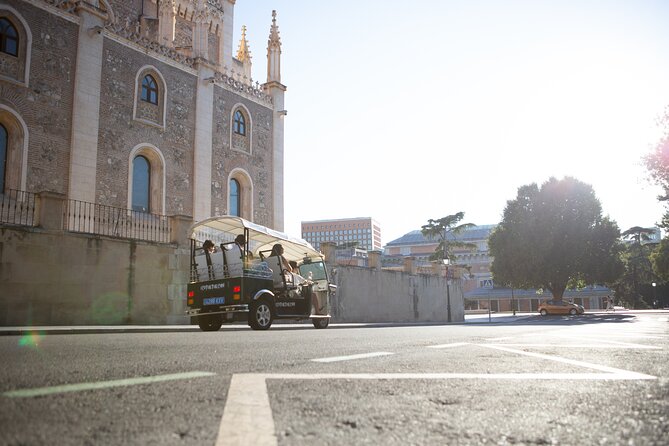
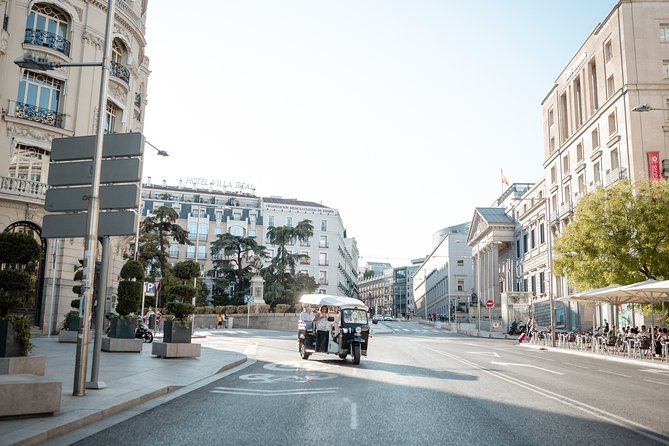
The vehicle itself matters more than you might think. It’s 100% electric, covered, and built for the realities of Madrid weather. In cold or windy conditions, you get a blanket and protective layers so you’re not shivering through photo moments. And if you’re traveling with older folks, the drivers help with getting on.
You can also read our reviews of more guided tours in Madrid
The 2 to 4 hour plan: how the pacing really feels
This is a “highlights with guidance” format. Expect a route that links major monuments and neighborhoods in one smooth arc, plus scheduled stops for photos and viewpoints. The duration is listed as about 2 to 4 hours, and that range changes how much you’ll linger at each stop.
From the way guides talk about the day, the goal is clear: you get context first, then you see the place. On a compact route like this, that beats trying to play tour guide yourself with an app while you’re also figuring out where to stand.
A practical consideration: if streets are closed or there are demonstrations, the itinerary can shift. The tour also can reduce time if you’re delayed, and it can cancel if the delay is more than 15 minutes. So if you want a full, smooth run, arrive on time and build a little buffer around it.
Where you start: the Puerta del Príncipe meeting point
Meeting point detail is one of the biggest make-or-break pieces for this kind of tour. The start is at C. de Bailén, 4 (Centro, 28013 Madrid), near the Plaza de Oriente area. The important part: the pickup is by the bus/transport area in that zone, right by the Puerta del Príncipe.
If Calle Bailén 4 doesn’t show cleanly in maps, look up Puerta del Príncipe. Then find the stairs to access the station area. There you should spot Eco Tuk Tuk signage. If you get stuck, you can contact them by phone or WhatsApp at +34 696 99 78 89.
If you have mobility concerns and need help getting downstairs from the pickup point, contact them in advance by phone/WhatsApp (+34 696 99 78 89) or email ([email protected]) so they can support elevator access.
Stop-by-stop Madrid: what each landmark teaches you to notice
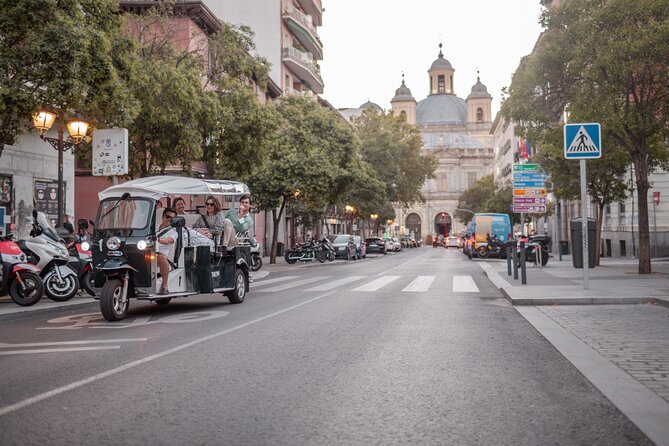
This tour strings together Madrid’s “you can’t miss” stops and then adds the meaning behind them. Here’s what each key location brings to the day, and what to look for when you’re there.
Mercado and Atocha: food culture plus Spain’s busiest rail hub
The day often begins around a covered market dating from about 1916. Expect an atmosphere built for everyday Spanish eating: local food, delicatessen-style items, and events. Markets are perfect early on because they ground you in how Madrid lives, not just how it looks.
Then the route swings toward Atocha Station, a major railway complex near Plaza del Emperador Carlos V. It’s the busiest station in Spain and one of the busiest across Europe. Even if you’re not going anywhere by train, the station helps you understand Madrid as a city that connects everything.
You can also read our reviews of more private tours in Madrid




Palacio de las Cortes and the Neptune Fountain: power, design, and public space
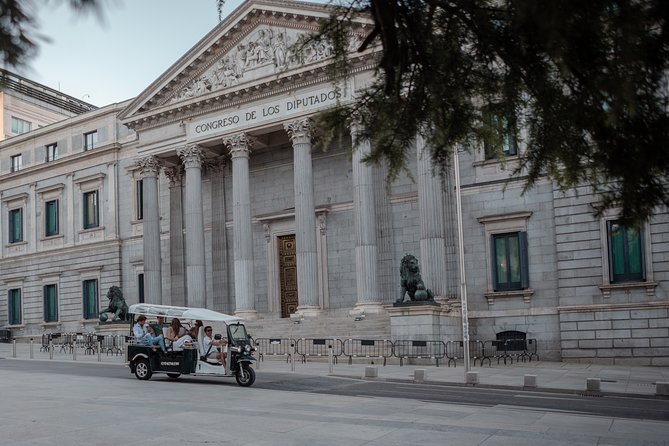
Next comes a strong political-and-architectural stop: the Palace of the Spanish Courts. It was built on the site of the former convent of the Holy Spirit, which once housed Congress in the early 1800s. When you look up at the facade, notice the neoclassical features: the staircase to the porch, the striking columns, the pediment with reliefs, and the lions flanking the entrance.
After that, you’ll see the Fountain of Neptune at the Plaza de Cánovas del Castillo. It’s neoclassical and designed to anchor the roundabout space. If you like how cities use sculpture to make intersections feel like squares, this is a good one to study.
Prado Museum area and San Jerónimo el Real: why Madrid is serious about art
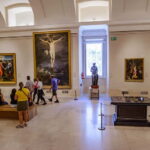
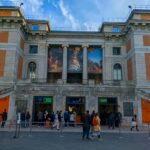
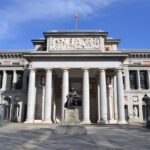
Madrid’s art reputation doesn’t come from posters. It comes from places like the Prado Museum. The tour uses the museum to explain the scale of European painting collected here, with major artists such as Velázquez, El Greco, Goya, plus Titian, Rubens, Bosch, and others. If you’re the type who only sees art once you step inside, this stop still helps because it tells you which names matter before you go.
Then you’ll likely visit San Jerónimo el Real, often called Los Jerónimos. It sits near the Prado and mixes late Gothic style with Renaissance influences from the early 1500s. What makes it more than a pretty facade is the connection to Spanish monarchy and royal rituals over centuries. The stairway leading to the door was built in 1906 for Alfonso XIII’s wedding—an easy detail to remember when you’re standing there.
The Plaza Santa Ana moment: a neighborhood square with a timeline
The Plaza de Santa Ana in the Cortes neighborhood is an open space that dates to 1810. Its appearance has shifted over time through multiple urbanization phases. When you stop here, it’s a good reset point: you get a neighborhood feel after the monumental architecture.
Churches with big meaning: San Francisco el Grande and Almudena Cathedral
The route also includes two major religious landmarks.
First is the Royal Basilica of San Francisco el Grande (officially the Basilica of Our Lady of the Angels). This is in the Palacio neighborhood within central Madrid’s historic area. Even if you don’t go inside, the stop helps you connect Madrid’s religious architecture to its historic heart.
Then comes Almudena Cathedral, Madrid’s most important religious building. It was consecrated on June 15, 1993, by Pope John Paul II, becoming the first consecrated cathedral outside Rome. If you’re into art and symbolism, the included museum concept matters too: the museum tells the story of the diocese of Madrid through mosaics and objects tied to the church’s history.
Royal Palace and Campo del Moro: where Madrid flexes royal power
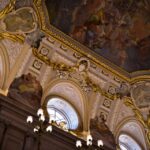
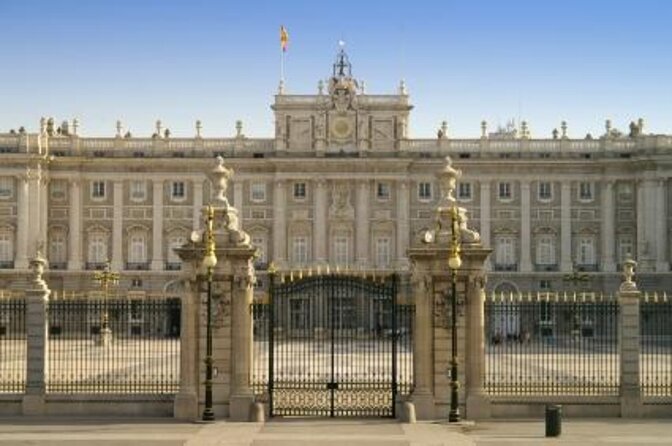
If Madrid has a “main stage,” the Royal Palace area is it. The palace (also called Palacio de Oriente) began construction in 1738, with seventeen years of works, and became the habitual residence of Carlos III in 1764.
You’re also guided through the idea of the palace’s surrounding gardens: Campo del Moro and the Sabatini Gardens. Campo del Moro stretches about 20 hectares, and the setting from the palace outward is one of the best ways to feel the scale of Madrid’s royal planning. Campo del Moro is described as historically significant from 1931, with a view corridor toward the promenade of the Virgin of the Port.
Templo de Debod: an Egypt-to-Madrid contrast that feels oddly perfect
One of the most surprising stops is Templo de Debod, an ancient Egyptian temple relocated to Madrid. It sits west of Plaza de España, near Paseo del Pintor Rosales, on a hill where the Mountain Barracks once stood. The tour notes 15 minutes and says the admission ticket is free.
This is a standout in a good way because it breaks the “all Spain all day” pattern. It gives you a Madrid moment that doesn’t feel like it has to prove its heritage. It just shows you how Madrid collects and reuses history.
Puerta de Alcalá: neoclassical triumphal arch with five openings
You’ll also see Puerta de Alcalá, a granite neoclassical triumphal arch designed by Francesco Sabatini. It was built at the order of Carlos III, inaugurated in 1778, and it’s notable for being among the first of its style in Europe after the fall of the Roman Empire.
The five openings are a key detail. Many triumphal arches use three openings; here you get a wider set, which affects how the monument feels in street view. It’s also named because it’s next to the road that led to Alcalá de Henares. When you’re there, it helps to look at both sides: the decorations are described as different depending on which facade you face.
Las Ventas bullring and the big sports streets: Madrid’s public drama
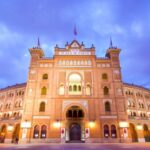
The tour includes Las Ventas, Madrid’s famous bullring, described as the biggest bullfighting landmark in Spain. It holds 81,044 spectators, was inaugurated December 14, 1947, and has a ring diameter listed as 61.5 m.
Even if you’re not into bullfighting, this stop works because it shows how Madrid builds venues for intense public events. Architecture and street culture meet here.
Then you may travel through parts of Paseo de la Castellana, toward the Santiago Bernabéu stadium area. You’ll also get time in Barrio Salamanca with major streets like Velázquez, Ortega y Gasset, and Serrano. It’s a shift in mood: more refined streets, more high-end city rhythm, and a different Madrid pace.
Columbus monument and Discovery Gardens: a photo-friendly science of wonder
At one point, the route goes by the Christopher Columbus monument. The white neo-Gothic sculpture stands about 17 meters tall and was built in 1885 by Jerónimo Suñol for celebrations tied to Alfonso XII and María de las Mercedes de Orleans. It sits in a square where traffic circles the fountain around it.
Nearby is the Gardens of Discovery, opened in 1970, with sculptures connected to discovery themes, including one dedicated to America’s discovery. If you want a calmer, green interlude after bigger roads, this area is a good fit.
National Library of Spain and the grand financial facades
The National Library of Spain (BNE) is another meaningful stop. It’s responsible for collecting, cataloging, and conserving Spain’s bibliographic heritage, with about 30 million publications produced in Spain since the early 1700s. The tour also points out that museum-style storytelling happens via exhibition halls and a museum museum setup.
The route also passes the area around major palaces and institutional buildings: Army Headquarters (Palacio de Buenavista), Casa de América (Palacio de Linares), City Council of Madrid (Palacio de Comunicaciones), and Banco de España. It’s like seeing Madrid’s official backbone in a single stretch—power, bureaucracy, culture all standing close together.
Cibeles fountain and Banco de España: what the city celebrates
The Fountain of Cibeles is a classic Madrid photo stop. It represents the Roman goddess Cibeles, symbolizing land, agriculture, and fertility, riding a car pulled by two lions. The goddess is described as carved in marble, with the lions also attributed to French sculptor work.
Cibeles also has a sports identity because it’s linked to Real Madrid celebrations. If you visit Madrid on a match day, you can imagine the energy this place absorbs.
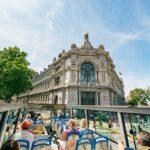
Finally, the tour includes Banco de España’s surroundings. The building is described as built to give the national bank a seat matching its importance, and it notes an award tied to the National Exhibition of Fine Arts in 1884. The key takeaway here is the visual message: Madrid’s institutions are designed to be seen.
Value check: is the $28.67 per person price fair for what you get?
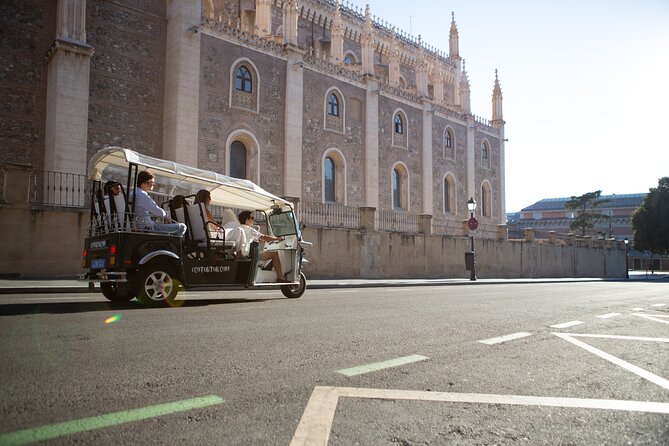
At $28.67 per person for a private electric tuk tuk ride lasting roughly 2 to 4 hours, the value tends to work best if you want a guided overview that doesn’t eat your whole day. You’re not paying for a bus tour experience. You’re paying for guide time plus a vehicle that can get you to streets that bigger vehicles can’t handle as well.
Also, because the tuk tuks are reserved privately and each vehicle has a legal max of 4 passengers, the per-person cost can feel especially reasonable when your group is 3 to 4 people. It turns the ride into something closer to a shared experience than a solo ticket.
Who should book this eco tuk tuk tour?
I think it fits best if:
- It’s your first time in Madrid and you want to get your bearings fast.
- You want a balance of major monuments plus real interpretation, not just drive-by photos.
- You’re traveling with someone who doesn’t want hours of uphill walking.
- You care about history and design, but still want the day to feel relaxed.
It may feel less ideal if:
- You hate structure and want unlimited stops on demand.
- You’re hoping for lots of long, interior museum time at multiple major institutions.
- You’re very flexible with plans, since delays can shorten the tour and route adjustments can happen due to closures or demonstrations.
Should you book this eco tuk tuk tour of Madrid?
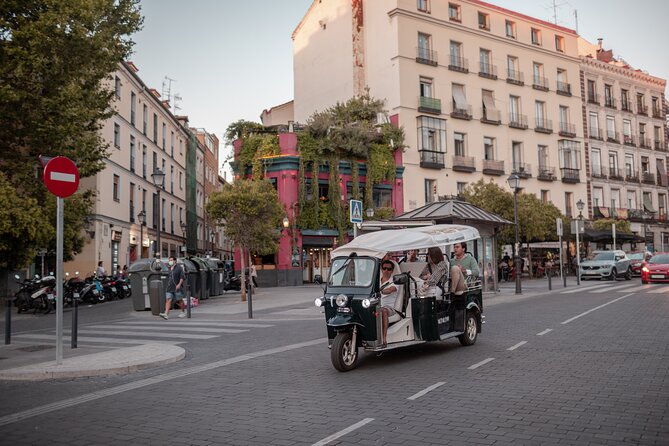
If you want a guided Madrid overview that is weather-smart, efficient, and private, I’d book it—especially early in your trip. This tour’s strength is the combination: a high-meaning route tied to history and culture, plus the comfort of an electric tuk tuk with blankets and protective layers.
Just go in knowing it’s a planned ride, not a free-form city wandering pass. If that matches your travel style, you’ll leave with a mental map of Madrid that makes the rest of your days easier.
FAQ
How long is the Madrid Expert Plus Tour?
The tour duration is listed as about 2 to 4 hours.
Is this tour private?
Yes. The tuk tuk is reserved privately, and only your group participates.
What language is the tour offered in?
It’s offered in English.
Do you provide protection for cold or rain?
Yes. In winter you receive blankets, and protective layers against rain and wind are provided for cold weather.
Where is the meeting point?
It starts at C. de Bailén, 4, Centro, 28013 Madrid, near the Plaza de Oriente area and the Puerta del Príncipe transit access. The pickup point is described as being right next to the Royal Palace.
Are pets allowed and is there a minimum age or weight requirement?
Pets are not allowed. The minimum age is 2 years (babies not allowed), and there is a minimum weight requirement of 9 kg.